%20--%3e%3csvg%20width='42mm'%20height='64mm'%20viewBox='0%200%2041.999999%2064.000001'%20version='1.1'%20id='svg1'%20xml:space='preserve'%20inkscape:version='1.4.4%20(dcaf3e7d9e,%202026-05-05)'%20sodipodi:docname='adkumo-cards-color.svg'%20xmlns:inkscape='http://www.inkscape.org/namespaces/inkscape'%20xmlns:sodipodi='http://sodipodi.sourceforge.net/DTD/sodipodi-0.dtd'%20xmlns='http://www.w3.org/2000/svg'%20xmlns:svg='http://www.w3.org/2000/svg'%3e%3csodipodi:namedview%20id='namedview1'%20pagecolor='%23ffffff'%20bordercolor='%23000000'%20borderopacity='0.25'%20inkscape:showpageshadow='2'%20inkscape:pageopacity='0.0'%20inkscape:pagecheckerboard='0'%20inkscape:deskcolor='%23d1d1d1'%20inkscape:document-units='mm'%20inkscape:zoom='1.4142136'%20inkscape:cx='57.275649'%20inkscape:cy='123.39013'%20inkscape:window-width='1854'%20inkscape:window-height='1011'%20inkscape:window-x='66'%20inkscape:window-y='32'%20inkscape:window-maximized='1'%20inkscape:current-layer='g6528'%20/%3e%3cdefs%20id='defs1'%20/%3e%3cg%20inkscape:label='Layer%201'%20inkscape:groupmode='layer'%20id='layer1'%20transform='translate(-223.82077,-58.584489)'%3e%3cg%20id='g6528'%20transform='translate(9.9863014,0.36985863)'%3e%3crect%20style='fill:%239a5bfd;fill-opacity:1;stroke-width:0.229954'%20id='rect1'%20width='20'%20height='20'%20x='213.83447'%20y='58.21463'%20ry='5'%20/%3e%3crect%20style='fill:%239a5bfd;fill-opacity:1;stroke-width:0.229953'%20id='rect1-8'%20width='20'%20height='20'%20x='235.83447'%20y='102.21463'%20ry='5'%20/%3e%3crect%20style='fill:%23fd3c80;fill-opacity:1;stroke-width:0.229953'%20id='rect1-1'%20width='20'%20height='20'%20x='213.83447'%20y='80.21463'%20ry='5'%20/%3e%3crect%20style='fill:%23fd8902;fill-opacity:1;stroke-width:0.229953'%20id='rect1-1-0'%20width='20'%20height='20'%20x='213.83447'%20y='102.21463'%20ry='5'%20/%3e%3crect%20style='fill:%2305e09b;fill-opacity:1;stroke-width:0.229953'%20id='rect1-1-6-7'%20width='20'%20height='20'%20x='235.83447'%20y='58.21463'%20ry='5'%20/%3e%3crect%20style='fill:%23307eeb;fill-opacity:1;stroke-width:0.229953'%20id='rect1-1-6-7-4'%20width='20'%20height='20'%20x='235.83447'%20y='80.21463'%20ry='5'%20/%3e%3c/g%3e%3c/g%3e%3c/svg%3e)

What Jasper Does Well
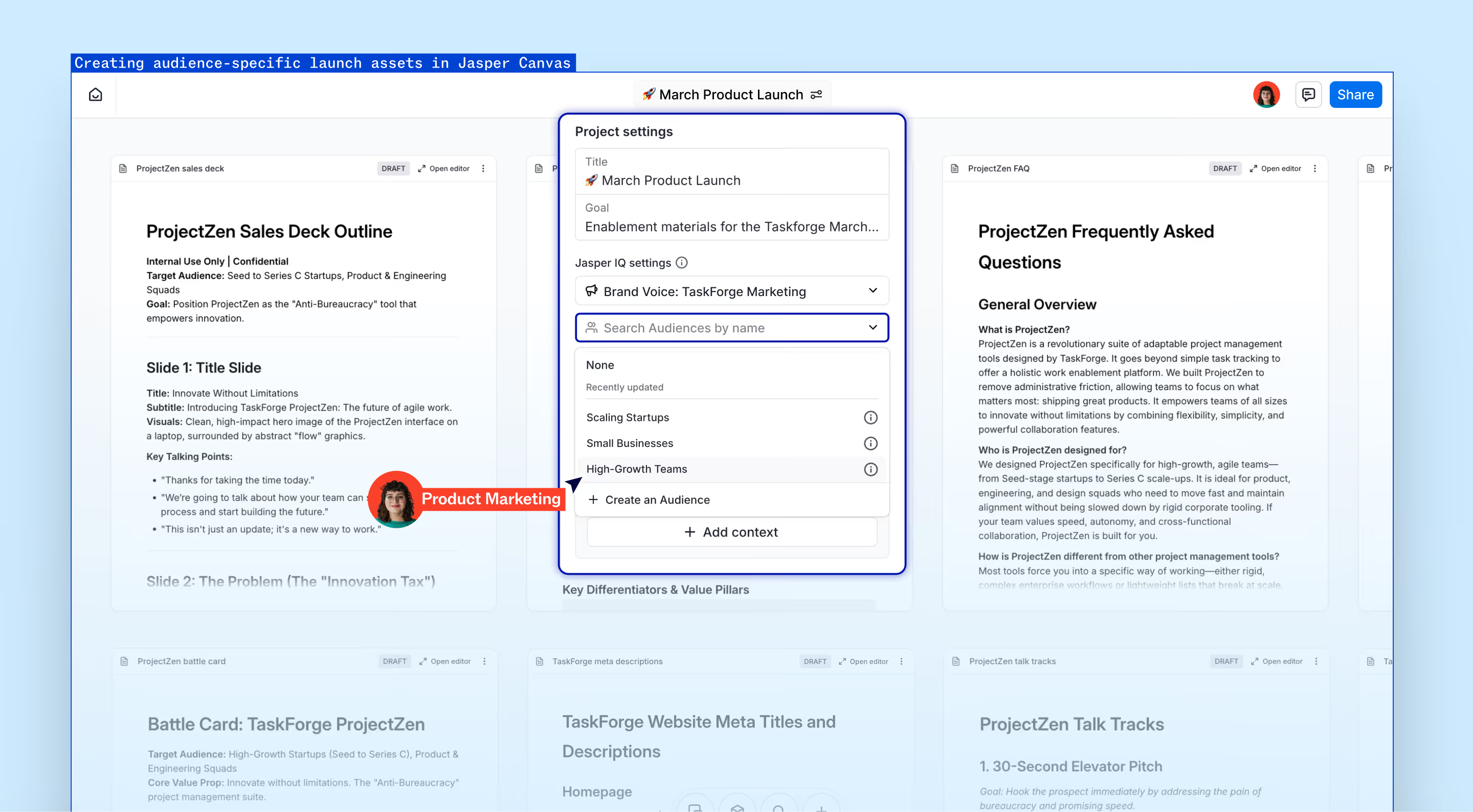
Jasper built a strong reputation as a general-purpose AI writing tool by focusing on copy quality and breadth. For teams that need to produce a wide variety of written content, from blog posts and email sequences to landing pages and social captions, Jasper delivers solid output with a relatively low learning curve. Its template library covers dozens of formats, and the brand voice system can store tone guidelines that nudge outputs in the right direction.
The AI copy quality is genuinely good. Jasper uses capable underlying models and adds a layer of marketing-specific fine-tuning that produces copy that reads more naturally than raw model output. For writers who want to accelerate drafting rather than replace it, Jasper fits that workflow well. The document editor handles long-form content cleanly, and the integration with tools like Surfer SEO makes it a defensible choice for content marketing teams running a blog-heavy strategy.
Where Jasper particularly shines is in organizations with a dedicated content team that needs to output a high volume of written assets across many formats. The workflow is familiar: open a template, fill in context, generate, refine. That loop is fast and predictable.
- High-quality AI copy generation. Jasper produces fluent, natural-sounding copy across formats, with less cleanup required than generic model output.
- Extensive template library. Hundreds of pre-built templates cover ad copy, blog outlines, email sequences, product descriptions, and more.
- Brand voice features. Store tone guidelines, writing samples, and style rules that nudge outputs toward your preferred register.
- Third-party integrations. Connects with tools like Surfer SEO, Google Docs, and Chrome for inline writing assistance.
- Strong documentation and community. A large user base means abundant tutorials, prompt recipes, and peer support for getting started.
Where Jasper Falls Short for Ad Creative Teams
Jasper's architecture is built around writing, not ad creative production. That difference becomes obvious the moment a growth team tries to use it for their actual workflow. The tool can generate ad copy, but generating copy is only one step in shipping a paid ad.
Consider a concrete scenario: a growth marketer wants to run a new campaign for a product launch. They need to know what competitors are running, identify hook angles that are working in the category, produce copy variants for three placements, pair each with an on-brand visual, and export everything in platform-ready sizes. Jasper handles one of those steps. Every other step requires a separate tool, and the brand consistency breaks down at each handoff.
The visual gap is particularly significant. Paid ads are visual-first media. A tool that produces text but no images forces the team back to a designer or a separate image generation tool for every single creative, eliminating much of the time savings. And when the copy and the visual are produced in different tools with different brand context, the result often feels assembled rather than cohesive.
- No competitor ad research. There is no way to see what rivals are running, which means every brief starts from scratch rather than from market data.
- No visual generation for ads. Copy is produced but visuals require a separate tool, breaking the creative workflow into at least two platforms.
- No ad-specific prompt system. Templates are generic marketing copy templates, not built around the structure of hooks, bodies, and CTAs for specific ad placements.
- Manual platform adaptation. Copy generated in Jasper must be manually resized and reformatted for Meta, Google, and LinkedIn character limits and placement specs.
- No campaign-level coordination. There is no concept of a campaign containing related creatives across placements, making it hard to maintain message consistency across a full launch.
- Brand DNA is copy-only. Jasper's brand voice system captures tone and language but cannot encode visual identity, colors, or typography, so visual consistency depends entirely on downstream tools.
Real-World Scenario: Same Campaign, Two Tools
A growth team at a B2C SaaS company needs to launch a retargeting campaign for a feature announcement. They have one week and two people.
With Jasper, the workflow looks like this: write a brief, generate hook variants in Jasper, manually adapt each variant for Meta and LinkedIn character limits, send copy to a designer for visuals, wait for the designer, receive assets in varying sizes, re-check brand consistency, and upload manually to each platform. The copy is good, but the process has four handoffs and takes most of the week.
With Adkumo, the same team opens the competitor ad repository, finds three recent ads from rivals in the same category, identifies which hook angles are getting engagement, and feeds one into the Remixer. The remixer applies their brand DNA and produces copy variants, paired visuals, and platform-sized exports in one session. The team reviews, makes conversational edits in the post editor, and exports everything to Meta and LinkedIn the same afternoon. The campaign launches in two days with higher brand consistency than the Jasper workflow would have produced in five.
Adkumo vs Jasper AI
| Funzionalità | Adkumo | Jasper AI |
|---|---|---|
| Intelligence & Research | ||
| Competitor Ad RepositoryBrowse and monitor rival ads across Meta, Google, and LinkedIn | ||
| AI RemixerTurn any inspiration ad into a brand-consistent variant in one click | ||
| Competitor Tracking AlertsGet notified when tracked competitors launch new creatives | ||
| Creative Production | ||
| AI Copy GenerationGenerate hooks, body copy, and CTAs using large language models | ||
| AI Visual GenerationGenerate and edit ad images without leaving the platform | ||
| Ad-Specific PromptsPrompt system built around ad formats, placements, and hooks | ||
| Multi-Platform Format VariantsAuto-generate square, portrait, and landscape variants from one creative | ||
| Long-Form Content (Blogs, Emails)Write blog posts, newsletters, and general marketing copy | ||
| Brand Management | ||
| Brand Voice LearningAnalyze and apply your unique tone, vocabulary, and style | ||
| Visual Brand DNAEncode colors, typography, and visual identity for consistent creatives | ||
| Multi-Brand SupportManage distinct brand profiles with isolated DNA and voice | Paid add-on | |
| Multi-Language Ad GenerationGenerate brand-consistent ads in EN, DE, FR, and IT | ||
| Workflow & Export | ||
| Ad Campaign-Level WorkflowCoordinate copy, visuals, and formats at the campaign level | ||
| Platform-Ready ExportExport assets sized and formatted for each ad platform automatically | ||
| Ad Performance AnalyticsTrack creative performance and identify top-performing patterns | ||
| Template LibraryPre-built templates for common content and ad formats | ||
Pricing Approach: Per Seat vs Per Creative
Jasper prices by seat and word output, which reflects its positioning as a general writing assistant for content teams. The more writers you have, the more you pay, and the pricing tiers are designed around team size rather than output volume.
Adkumo prices around ad creative production. Because the tool handles the full workflow, from research through export, the value unit is a completed, platform-ready creative rather than a word count or a seat license. For a lean growth team of two or three people shipping twenty to fifty ad variants per month, that structure means significantly lower per-creative cost than paying per-seat for a tool that only handles the copy step.
The distinction matters most when you factor in tool consolidation. Teams using Jasper for ad copy typically also pay for a separate design tool, a competitor research subscription, and an ad management platform. Adkumo consolidates the first two into one bill. For ad-focused teams, the total cost of the Jasper-plus-four-tools stack is usually higher than a single Adkumo subscription.
Who Should Choose Which Tool
Choose Jasper If:
- You need diverse content types across blogs, emails, scripts, and social content
- Ad creative represents a small fraction of your total content output
- You have a dedicated designer handling all visual production
- You want a general-purpose AI writing assistant for a broad content team
- SEO-optimized long-form content is your primary growth channel
Choose Adkumo If:
- Paid ad campaigns are your primary growth channel
- You want an end-to-end workflow from competitor research to platform export
- Brand voice consistency across copy and visuals is critical
- You need hooks, body copy, and visuals produced together, in one tool
- You are consolidating a multi-tool ad stack into something leaner
- You want to start from market data rather than a blank brief
Why Teams Switch to Adkumo
Teams that primarily ship ad creatives often find Jasper's broad capabilities introduce complexity and tool sprawl they did not sign up for. The pivot to Adkumo is usually driven by one of three frustrations: the visual production gap, the lack of competitor context, or the time spent adapting copy for each platform manually.
- Faster time to platform-ready creatives. The full workflow, from research to export, happens in one session rather than across multiple tools and handoffs.
- Competitor context built into every brief. The ad repository means creative decisions are informed by what the market is actually running, not just internal assumptions.
- Visual and copy brand consistency. Because Adkumo applies brand DNA to both copy and visuals, the output looks and sounds like the same brand, not two separate workflows stitched together.
- Campaign-level thinking built in. Creatives are organized at the campaign level, making it easier to maintain message coherence across placements and audiences.
- Lower total cost for ad-focused teams. Replacing a four-tool stack with one purpose-built platform almost always reduces total spend.
How to Switch from Jasper to Adkumo
Migrating from Jasper is straightforward because Adkumo does not require importing historical content. The transition is about setting up your brand context, not moving files.
- Export your Jasper brand voice settings. Copy your tone guidelines, writing samples, and any brand style rules from Jasper. These become the starting point for your Adkumo brand DNA setup, which you can paste in directly or use to guide the onboarding questions.
- Set up your brand profile in Adkumo. Run through the brand DNA setup: upload your logo, define your color palette and typography, and paste in your voice examples. This typically takes twenty to thirty minutes. Adkumo will analyze your inputs and generate an initial brand profile you can refine.
- Seed the ad repository with competitor research. Add your top three to five competitors to the Competitors tab. Adkumo will pull their recent ads, giving you an immediate view of what the category is running. This context replaces the blank-brief starting point Jasper requires.
- Run your first campaign through the new workflow. Take an active or recently completed campaign brief and run it through Adkumo from research to export. Use the Remixer on one or two competitor ads to see how your brand DNA applies. Most teams produce their first complete ad batch in the same session, and that first run typically reveals the workflow differences more clearly than any comparison document.
Domande Frequenti
Ready to Spy, Remix, and Ship?
A competitor ad repository plus a brand-aware Remixer, Jasper has neither.
Esplora Altro
AI Ad Campaigns: End-to-End Creative Generation
See how Adkumo handles the full ad creative workflow from research to export
Brand Voice AI: How We Learn Your Tone
Deep dive into how Adkumo encodes and applies your brand DNA
AdCreative.ai Alternative: Side-by-Side Comparison
Compare Adkumo against AdCreative.ai for ad creative workflows
AI Ad Generator: Built on Proven Creatives
Explore how the competitor ad library feeds your creative strategy
Gemini Alternative: Feature Breakdown
Compare Adkumo against Gemini for paid ad teams