%20--%3e%3csvg%20width='42mm'%20height='64mm'%20viewBox='0%200%2041.999999%2064.000001'%20version='1.1'%20id='svg1'%20xml:space='preserve'%20inkscape:version='1.4.4%20(dcaf3e7d9e,%202026-05-05)'%20sodipodi:docname='adkumo-cards-color.svg'%20xmlns:inkscape='http://www.inkscape.org/namespaces/inkscape'%20xmlns:sodipodi='http://sodipodi.sourceforge.net/DTD/sodipodi-0.dtd'%20xmlns='http://www.w3.org/2000/svg'%20xmlns:svg='http://www.w3.org/2000/svg'%3e%3csodipodi:namedview%20id='namedview1'%20pagecolor='%23ffffff'%20bordercolor='%23000000'%20borderopacity='0.25'%20inkscape:showpageshadow='2'%20inkscape:pageopacity='0.0'%20inkscape:pagecheckerboard='0'%20inkscape:deskcolor='%23d1d1d1'%20inkscape:document-units='mm'%20inkscape:zoom='1.4142136'%20inkscape:cx='57.275649'%20inkscape:cy='123.39013'%20inkscape:window-width='1854'%20inkscape:window-height='1011'%20inkscape:window-x='66'%20inkscape:window-y='32'%20inkscape:window-maximized='1'%20inkscape:current-layer='g6528'%20/%3e%3cdefs%20id='defs1'%20/%3e%3cg%20inkscape:label='Layer%201'%20inkscape:groupmode='layer'%20id='layer1'%20transform='translate(-223.82077,-58.584489)'%3e%3cg%20id='g6528'%20transform='translate(9.9863014,0.36985863)'%3e%3crect%20style='fill:%239a5bfd;fill-opacity:1;stroke-width:0.229954'%20id='rect1'%20width='20'%20height='20'%20x='213.83447'%20y='58.21463'%20ry='5'%20/%3e%3crect%20style='fill:%239a5bfd;fill-opacity:1;stroke-width:0.229953'%20id='rect1-8'%20width='20'%20height='20'%20x='235.83447'%20y='102.21463'%20ry='5'%20/%3e%3crect%20style='fill:%23fd3c80;fill-opacity:1;stroke-width:0.229953'%20id='rect1-1'%20width='20'%20height='20'%20x='213.83447'%20y='80.21463'%20ry='5'%20/%3e%3crect%20style='fill:%23fd8902;fill-opacity:1;stroke-width:0.229953'%20id='rect1-1-0'%20width='20'%20height='20'%20x='213.83447'%20y='102.21463'%20ry='5'%20/%3e%3crect%20style='fill:%2305e09b;fill-opacity:1;stroke-width:0.229953'%20id='rect1-1-6-7'%20width='20'%20height='20'%20x='235.83447'%20y='58.21463'%20ry='5'%20/%3e%3crect%20style='fill:%23307eeb;fill-opacity:1;stroke-width:0.229953'%20id='rect1-1-6-7-4'%20width='20'%20height='20'%20x='235.83447'%20y='80.21463'%20ry='5'%20/%3e%3c/g%3e%3c/g%3e%3c/svg%3e)
Your Ads Don't Have a Creativity Problem. They Have a Consistency Problem.
Brands chase novel creative when their real problem is inconsistency across ads, channels, and time. Why consistency beats novelty, and how to make it the default.
Every founder I talk to is convinced their ads are underperforming because they are not creative enough. They want a wilder hook, a fresher angle, a video nobody has seen before. So they burn a week chasing the next clever idea, ship it, watch it flatline, and conclude they need to be even more creative next time.
I think that is the wrong diagnosis. After looking at thousands of ad accounts, I have come to believe most brands do not have a creativity problem. They have a consistency problem. Their ads look like they came from five different companies, because in practice they did: a different freelancer, a different week, a different mood. And inconsistency is far more expensive than boring.
Recognition is the real job of an ad
We like to imagine each ad is a tiny persuasion machine that has to win on its own merits. It is not. Most people will see your ad in a half-second scroll, ignore it, and move on. The ad that eventually converts is rarely the one that finally cracked the perfect message. It is the one that showed up for the seventh time and finally got recognized.
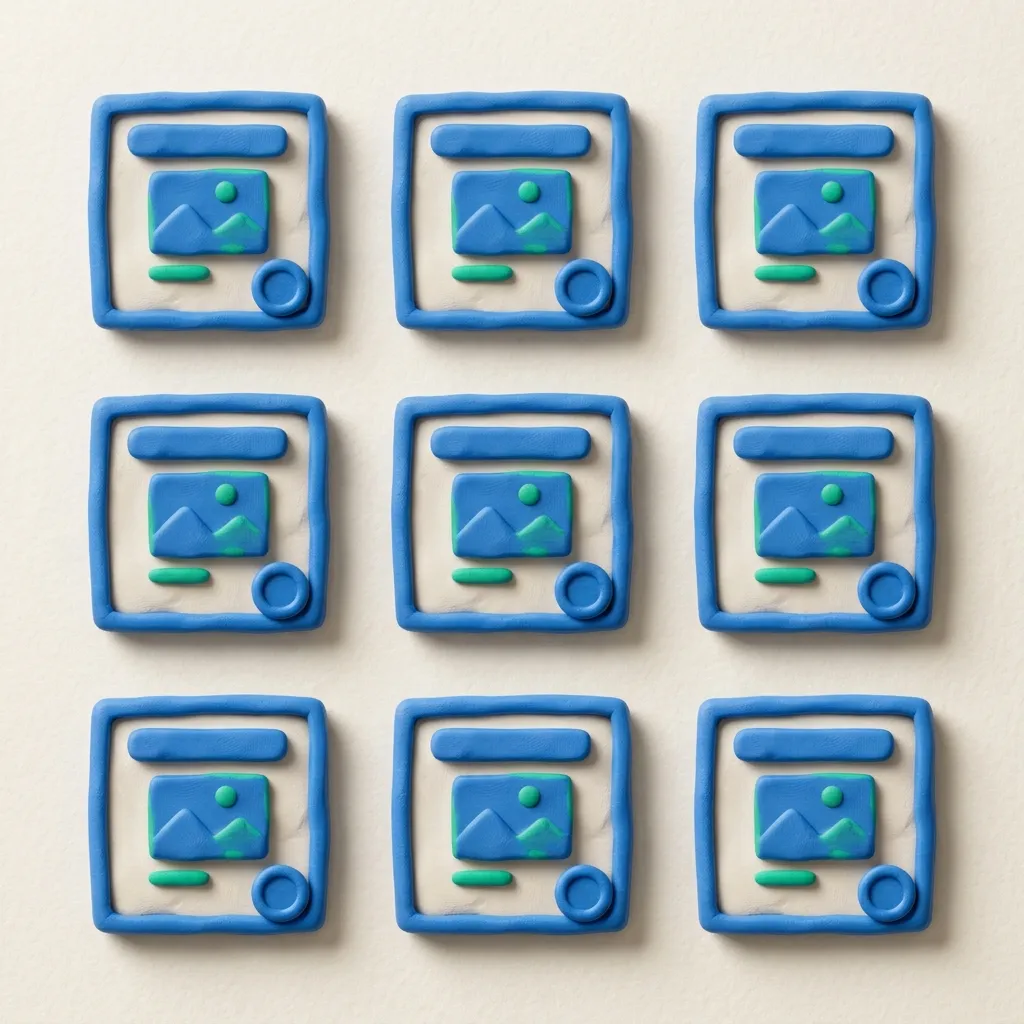
Recognition is built through repetition of the same cues: the same blue, the same typeface, the same layout rhythm, the same voice. When every ad shares those cues, each impression compounds the last one. When every ad reinvents itself, each impression starts from zero. You are paying for reach and throwing away the memory.
What inconsistency actually costs
Inconsistency does not just waste impressions. It quietly erodes the two things that make ads work at all.
- Recognition. A prospect cannot build familiarity with a brand that looks different every time. You restart the relationship on every impression instead of deepening it.
- Trust. Mismatched colors, fonts, and tone read as amateur, even when each individual ad is fine. People infer the quality of the product from the coherence of the marketing.
- Learning. When your ads have nothing in common, you cannot tell what is actually driving results. Was it the angle, the color, the format? You have confounded every variable, so you learn nothing you can repeat.
The cruel part is that none of this shows up as a single dramatic failure. It shows up as a slow tax on everything, a few points off your click-through here, a little less recall there, until the whole account underperforms and nobody can point to why.
Why consistency beats novelty
The brands you admire are not winning because they are endlessly inventive. They are winning because they are relentlessly consistent. Think of the campaigns that live in your head. They almost always run the same structure, the same palette, and the same voice for years, and they change one variable at a time on purpose.
That discipline is what turns a pile of ads into a brand. Novelty feels productive because it is busy. Consistency feels boring because it is repetitive. But repetition is the entire point. An ad that looks like your last ten ads is doing the most valuable thing an ad can do, which is reminding people who you are.
This is also why proven patterns matter so much. A layout that has already proven it can stop a scroll, repeated in your colors and your voice, beats a brilliant one-off almost every time. In most cases your best ad already exists, and your job is to make it look like yours. You get the upside of a tested format and the compounding upside of looking like yourself.
Consistency is a system, not a vibe
Here is the catch. Consistency is genuinely hard to maintain by hand. The moment you scale past a handful of ads, across formats, channels, and languages, somebody is eyeballing a hex code, somebody is guessing at the tone, and the family resemblance starts to drift. It is not a discipline problem. It is a throughput problem.
The fix is to make consistency the default instead of a thing you police. Codify the brand once into a reusable brand DNA, the voice, the colors, the type, the structures that work, and then make every new ad inherit it automatically. A simple three-layer framework keeps the strategy, the brand, and the execution separated so the family resemblance survives scale. When staying on-brand is the path of least resistance, you stop relying on heroic attention to detail and start getting coherence for free.
That is exactly the bet I made when I built Adkumo. You set your brand DNA once, then any ad you adopt inherits your voice, your colors, and your structure automatically, so coherence is the default rather than a thing you babysit. Consistency stops being a chore and becomes the way the tool works. If keeping every ad recognizably yours sounds like the boring win you have been missing, it is worth a quiet look.
The bottom line
The next time an ad underperforms, resist the urge to reach for a more clever idea. Ask the harder question first: does this ad look, sound, and feel like the rest of my brand, or did I just start over again? Most of the lift you are chasing through novelty is sitting right there in consistency, unclaimed.
Be boring on purpose. Pick a voice, a palette, and a set of structures that work, and run them until you are sick of them, because that is roughly the point at which your customers are finally starting to remember you.