%20--%3e%3csvg%20width='42mm'%20height='64mm'%20viewBox='0%200%2041.999999%2064.000001'%20version='1.1'%20id='svg1'%20xml:space='preserve'%20inkscape:version='1.4.4%20(dcaf3e7d9e,%202026-05-05)'%20sodipodi:docname='adkumo-cards-color.svg'%20xmlns:inkscape='http://www.inkscape.org/namespaces/inkscape'%20xmlns:sodipodi='http://sodipodi.sourceforge.net/DTD/sodipodi-0.dtd'%20xmlns='http://www.w3.org/2000/svg'%20xmlns:svg='http://www.w3.org/2000/svg'%3e%3csodipodi:namedview%20id='namedview1'%20pagecolor='%23ffffff'%20bordercolor='%23000000'%20borderopacity='0.25'%20inkscape:showpageshadow='2'%20inkscape:pageopacity='0.0'%20inkscape:pagecheckerboard='0'%20inkscape:deskcolor='%23d1d1d1'%20inkscape:document-units='mm'%20inkscape:zoom='1.4142136'%20inkscape:cx='57.275649'%20inkscape:cy='123.39013'%20inkscape:window-width='1854'%20inkscape:window-height='1011'%20inkscape:window-x='66'%20inkscape:window-y='32'%20inkscape:window-maximized='1'%20inkscape:current-layer='g6528'%20/%3e%3cdefs%20id='defs1'%20/%3e%3cg%20inkscape:label='Layer%201'%20inkscape:groupmode='layer'%20id='layer1'%20transform='translate(-223.82077,-58.584489)'%3e%3cg%20id='g6528'%20transform='translate(9.9863014,0.36985863)'%3e%3crect%20style='fill:%239a5bfd;fill-opacity:1;stroke-width:0.229954'%20id='rect1'%20width='20'%20height='20'%20x='213.83447'%20y='58.21463'%20ry='5'%20/%3e%3crect%20style='fill:%239a5bfd;fill-opacity:1;stroke-width:0.229953'%20id='rect1-8'%20width='20'%20height='20'%20x='235.83447'%20y='102.21463'%20ry='5'%20/%3e%3crect%20style='fill:%23fd3c80;fill-opacity:1;stroke-width:0.229953'%20id='rect1-1'%20width='20'%20height='20'%20x='213.83447'%20y='80.21463'%20ry='5'%20/%3e%3crect%20style='fill:%23fd8902;fill-opacity:1;stroke-width:0.229953'%20id='rect1-1-0'%20width='20'%20height='20'%20x='213.83447'%20y='102.21463'%20ry='5'%20/%3e%3crect%20style='fill:%2305e09b;fill-opacity:1;stroke-width:0.229953'%20id='rect1-1-6-7'%20width='20'%20height='20'%20x='235.83447'%20y='58.21463'%20ry='5'%20/%3e%3crect%20style='fill:%23307eeb;fill-opacity:1;stroke-width:0.229953'%20id='rect1-1-6-7-4'%20width='20'%20height='20'%20x='235.83447'%20y='80.21463'%20ry='5'%20/%3e%3c/g%3e%3c/g%3e%3c/svg%3e)
9 AI Ad Tools Worth Trying in 2026 (And 3 That Aren't)
An honest roundup of 9 AI ad tools worth trying in 2026 and 3 to skip, with what each is best for, pricing, and ratings, from a growth marketing consultant.

I spend most of my week advising growth teams on where to put their creative budget, and the same question lands in my inbox over and over: which AI ad tool is actually worth paying for in 2026? The category has exploded. Every week there is a new generator promising winning ads in one click, and most of them are forgettable. A handful are genuinely good, and a few are coasting on early hype while charging premium prices.
What follows is my honest shortlist. Nine tools I would point a client toward depending on their workflow, and three I would tell them to skip in 2026. I have no stake in any of these companies, so I will be blunt about where each one wins and where it quietly falls short.
How to choose before you read the list
"Best" means nothing without a yardstick, so before you compare logos, get honest about three things. They decide which tool fits far more than any feature list.
- Your primary format. Static and banners, short-form video, or pure inspiration and research are three different jobs, and almost no tool does all three well.
- Your starting point. Some tools start from a blank prompt, others start from ads that are already proven to work. The second path produces stronger creative far more reliably.
- Where it ends. The expensive gap in most stacks is the handoff. If a tool cannot push the finished ad to your actual channels, you will be exporting and re-uploading by hand forever.
Hold those three in mind as you read. Almost every disappointment I see with AI ad tools traces back to a mismatch on one of them.
AdCreative.ai: best for high-volume static generation
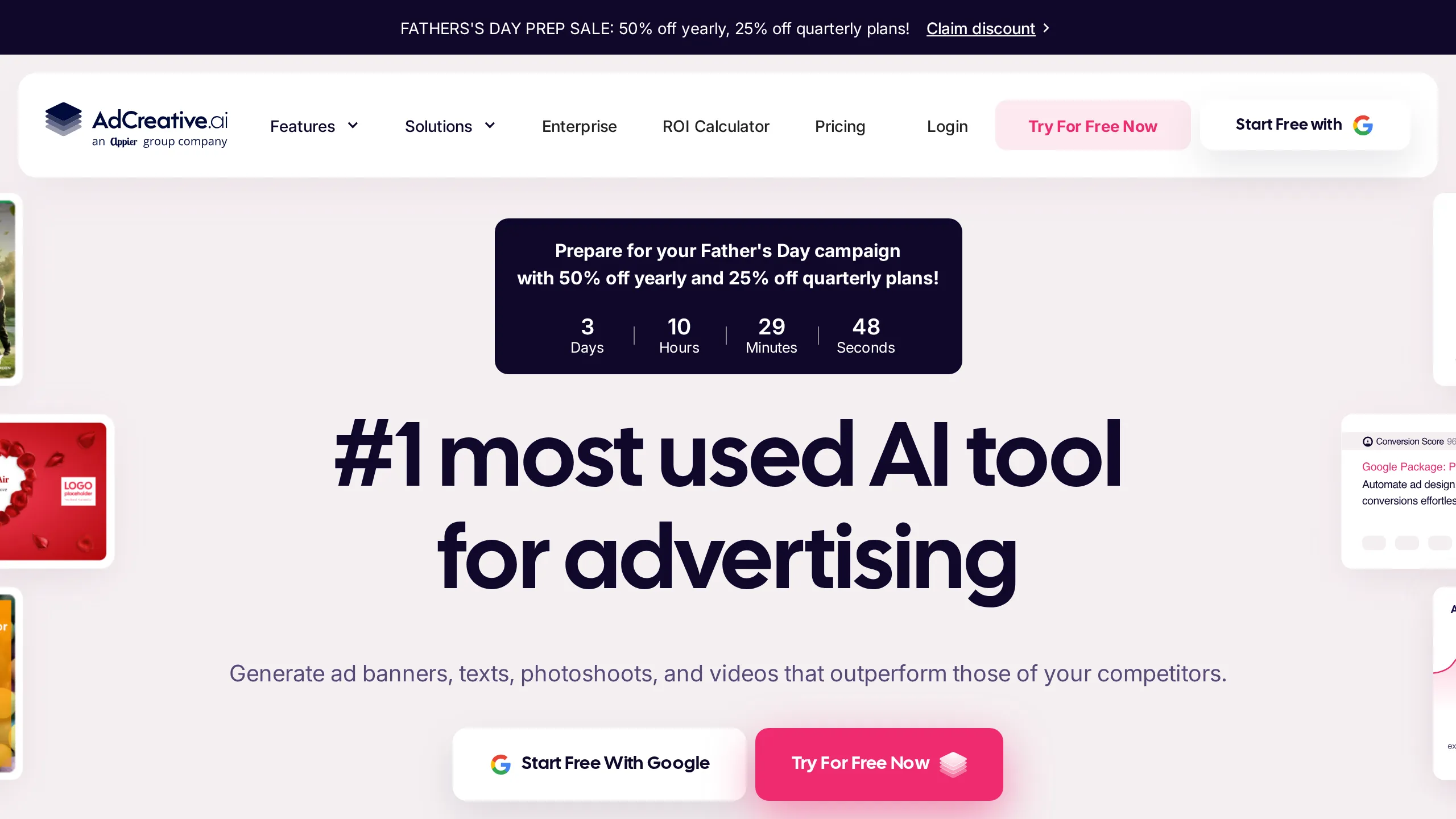
AdCreative.ai is usually the first name that comes up in this category, and at sheer throughput it delivers. Point it at your product and it spins up banners, headlines, AI product photoshoots, and short clips by the dozen, attaches a predicted conversion number to every asset, and ships the finished creative into Meta and Google Ads. The marketer staring down twenty static variants the night before launch will get real mileage out of it. Plenty of teams still end up weighing the AdCreative.ai alternatives once the bill and the sameness set in, but for raw volume it remains a defensible pick.
Best for. Marketers who need a high volume of static and banner variants fast, with a performance score on each asset, and who only run Meta and Google.
The honest catch. Once you have scrolled past a few hundred outputs they start to blur into the same handful of layouts, and the credit-based billing has earned a wary following. The split in its scores tells the story: roughly 4.3 on G2 versus about 3.6 on Trustpilot, almost entirely down to surprise-charge and refund threads. The 2026 price hikes stung too, with the professional tier now near 339 dollars a month even as the credit allowance tightened. Read the cancellation terms before the trial clock starts.
Creatify.ai: best for quick AI video ads
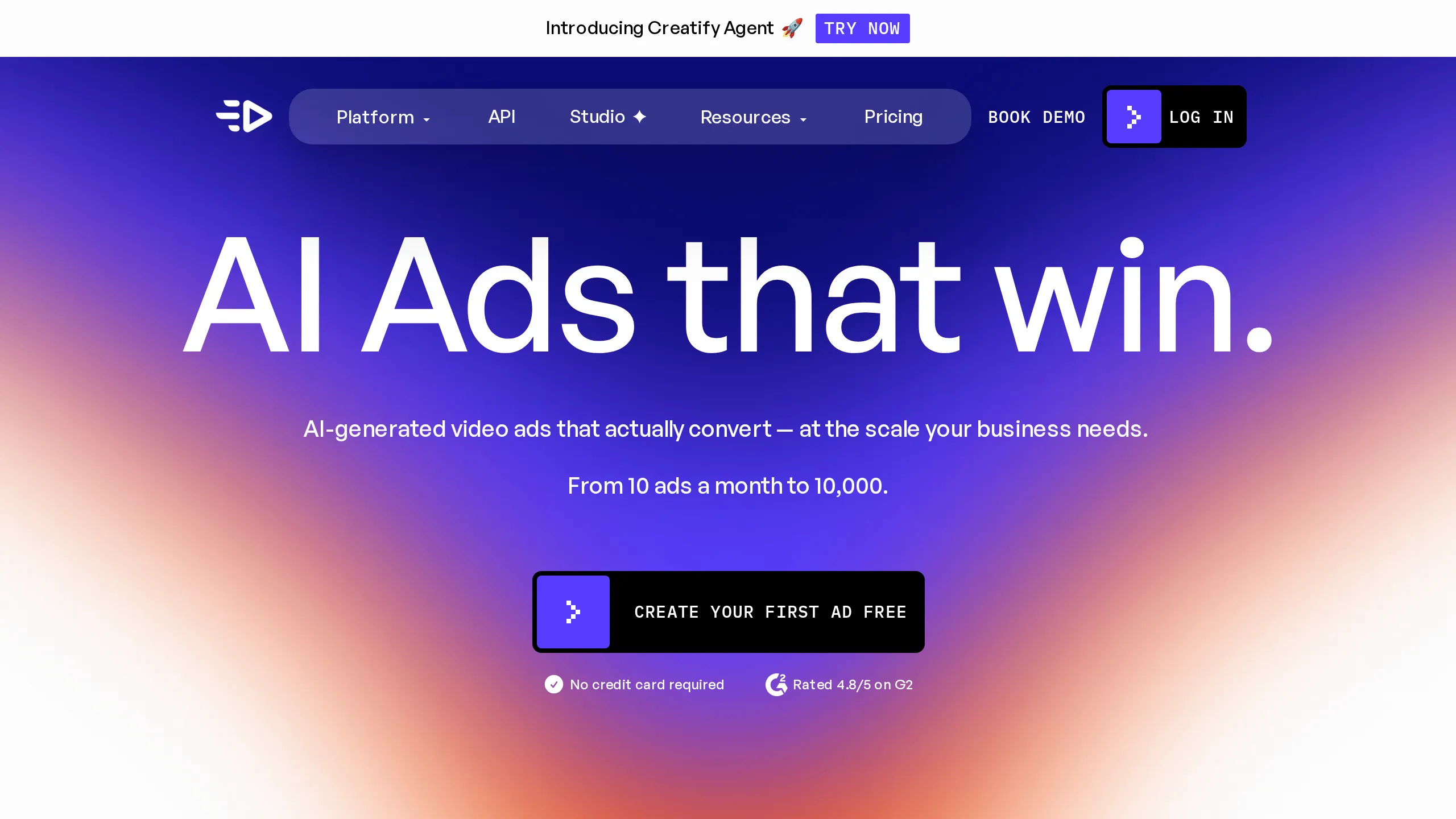
When the whole strategy rides on short-form video, Creatify gets you from idea to clip with the least friction of anything I have tried. Drop in a product URL or a few lines of copy and it builds out video ads voiced by AI avatars and dressed with captions and overlays, drawing on a roster of hundreds of presenters across dozens of languages. From there you can fan out variations, fire off built-in A/B tests, and publish directly to Meta and TikTok.
Best for. Dropshippers, e-commerce stores, and anyone who needs UGC-style video ads quickly without filming a thing.
The trade-offs. Its world is video, so the static half of your mix gets no help here. Look closely at the avatars and the lip-sync and gestures still tip into uncanny territory, and the credits drain quicker than the pricing page implies, with leftovers expiring before you can spend them. G2 scores stay high, yet the credit accounting is the gripe that keeps recurring. There is a free tier with capped credits, then about 19 dollars a month for Starter and 49 for Pro.
Foreplay: best for finding and briefing proven ads
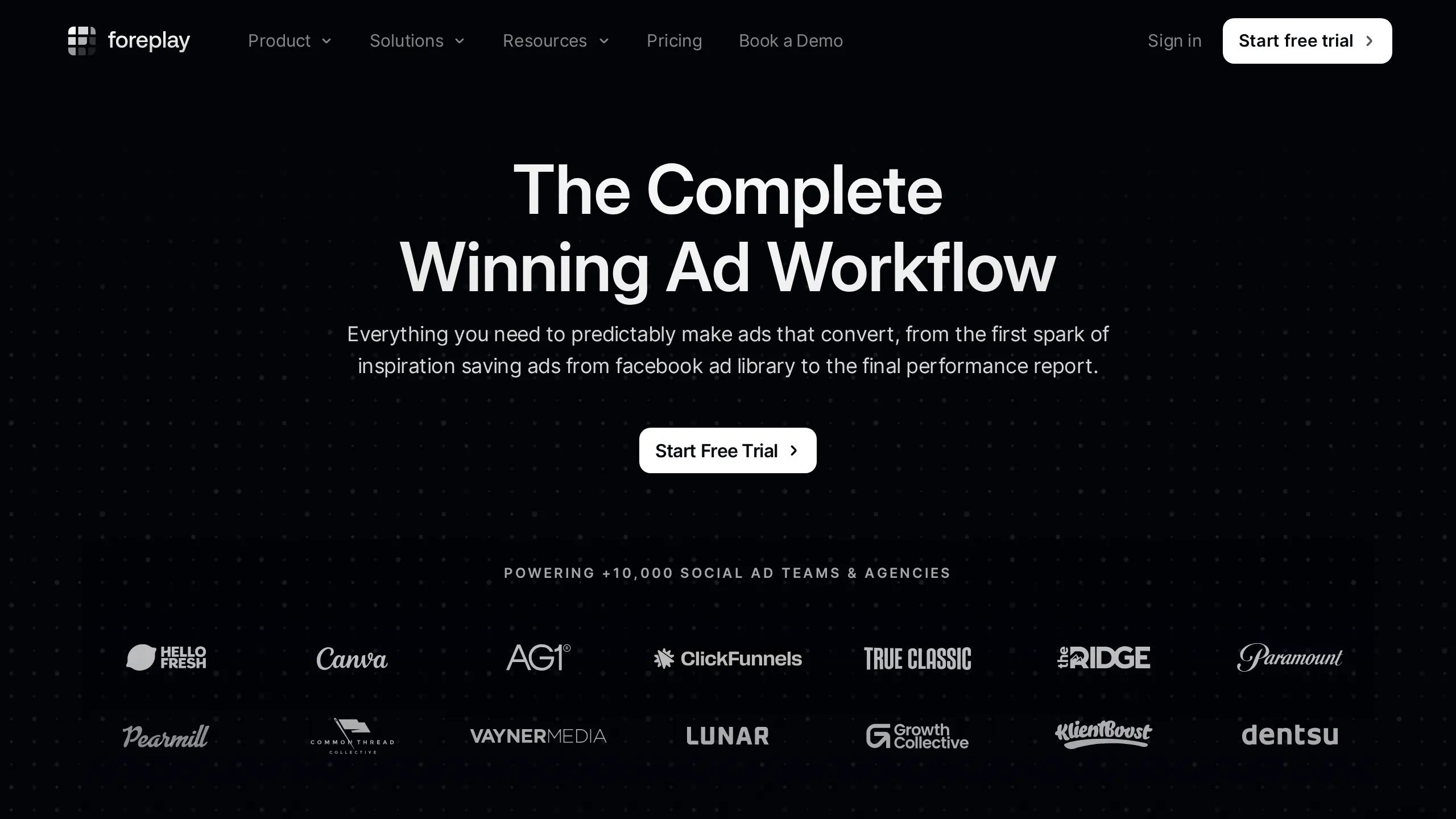
Foreplay is the tool I recommend most often for the part of the job that happens before generation. It is a massive, well-organized swipe file with one-click saving from the Facebook, TikTok, and LinkedIn ad libraries. Its Spyder feature tracks competitors, Lens analyzes creative performance, and Briefs turn a pile of reference ads into a clean creative direction for whoever produces the work.
Best for. Performance marketers and creative strategists who want a serious library of proven ads to study, organize, and brief from.
The honest catch. Foreplay is research and inspiration only. It does not generate on-brand creatives and it does not launch anything, so you find the winning ad and then take it elsewhere to build and ship it. Reviewers love it, around 4.8 on G2, but the price is the common gripe. The Basic plan is about 49 dollars a month annually for a single seat, and team plans climb into the hundreds.
Canva Magic Studio: best for flexible DIY design
Canva is not really an ad tool, and that is the point. It is the most approachable design suite on the planet, and its Magic Studio layer adds AI on top: Magic Design for layouts, Magic Write for copy, Dream Lab for images, and a Brand Kit that keeps your logos, colors, and fonts consistent. If you need a deck, a social post, and an ad in the same afternoon, nothing beats it for sheer flexibility.
Best for. Solopreneurs and small teams who want one affordable, easy tool for every kind of visual, not just ads. There is a real free tier, and Pro is about 15 dollars a month.
Where it falls down for ads. It was not built for ad performance. There is no conversion scoring, no library of proven ads to start from, and no native way to launch to Meta or LinkedIn, so you export and upload manually. The AI image output is convenient but a generation behind dedicated image models. Great design tool, not a paid-social engine.
Icon: best for human-filmed UGC at speed
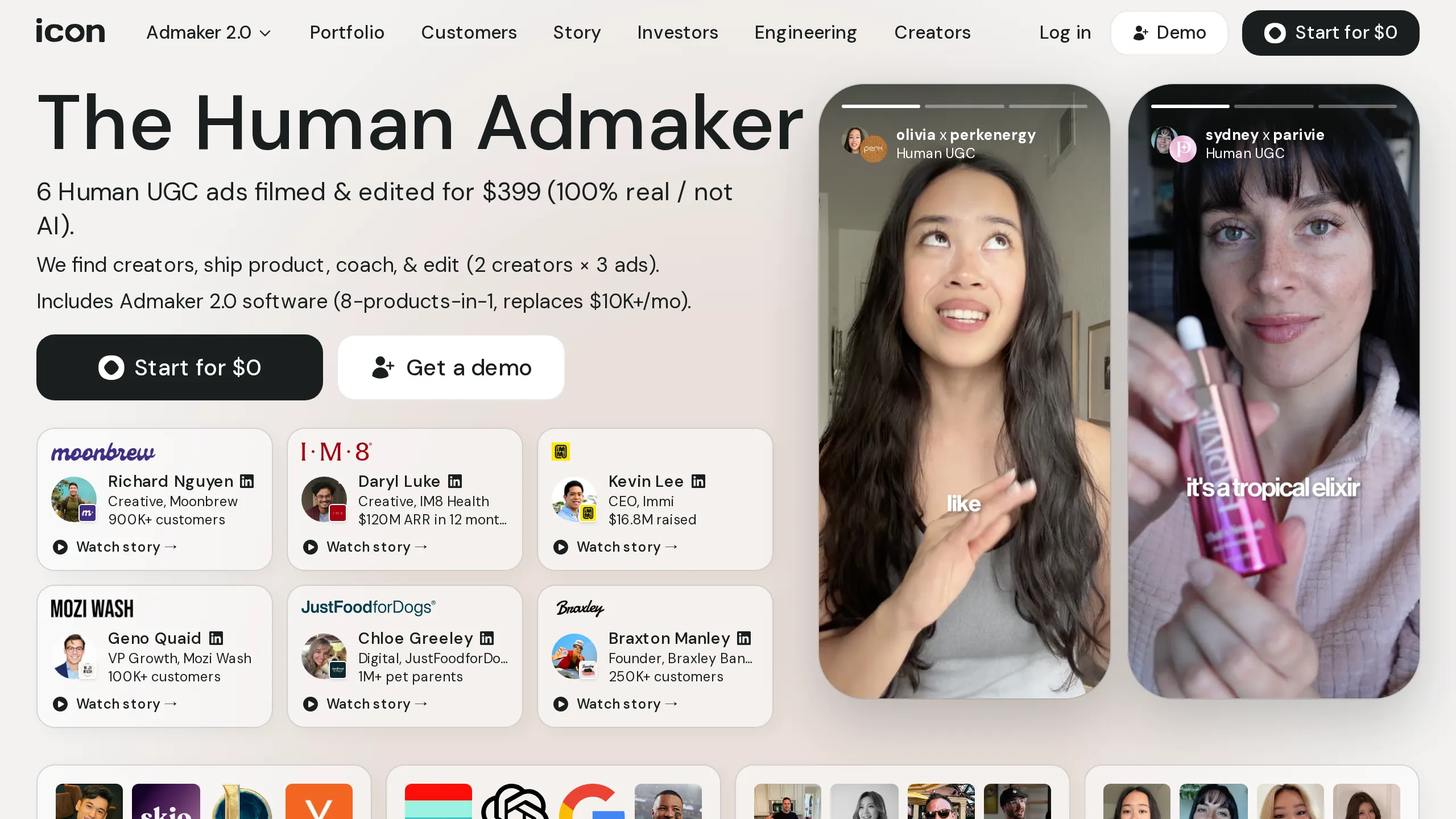
Icon takes a contrarian stance in a market drowning in synthetic avatars: the ads are filmed by real human creators, and the software handles the briefing, editing, competitor analysis, and one-click launch to Meta. Its entry offer is six human-filmed UGC ads for a flat fee, which undercuts the cost of sourcing creators yourself. It is backed by serious investors and has a credible roster of DTC brands.
Best for. DTC and e-commerce brands that want authentic, non-AI UGC video without managing a roster of creators by hand.
The honest catch. Because real humans film the work, turnaround is slower than a pure generator, and reviewers report rendering and export hiccups along with a cancellation flow that requires contacting support. The software-only tier starts around 39 dollars a month, but the value lives in the human-filmed packages, which cost more. It only launches to Meta.
Recraft: best for brand-consistent design assets

Recraft earns a spot the moment the artwork itself has to do the selling. Where it pulls ahead is control over the craft: crisp vector output, text that actually renders legibly, and a style engine that learns your look from a few reference uploads and holds it steady across every generation. That kind of repeatable visual identity is genuinely uncommon among image generators, which is why brand-minded founders keep it close.
Best for. Designers and brand-conscious founders who need on-style images, icons, and vectors rather than a full ad-production pipeline.
The honest catch. What Recraft produces is raw material, not a finished campaign. Nothing here scores conversions, surfaces a proven ad to build from, or pushes the result live, so it lands a step before the part of the funnel that actually spends money. Vector exports sometimes want a tidy-up, and the free tier publishes everything openly with no commercial license. The Pro plan stays gentle, from roughly 10 dollars a month on an annual term.
Three more worth a look
These three are excellent but more specialized, so I am keeping them short rather than giving each a hero shot.
- Pencil. An enterprise marketing operating system from The Brandtech Group that orchestrates many underlying models, generates video and static at volume, and scores creative with a predictive engine, wrapped in SOC 2 governance and IP indemnity. Self-serve tiers start around 14 dollars a month, but the real product is sales-gated for enterprise. Best for large teams and agencies, overkill for a lean brand.
- Smartly. The heavyweight for cross-channel creative automation across Meta, TikTok, Pinterest, and more, with documented performance lift on dynamic creative. It is enterprise-priced, with reported minimums of several thousand dollars a month and most implementations spending 50,000 dollars or more in media. Worth it only at real scale.
- Jasper. The strongest option if your bottleneck is copy and brand voice rather than visuals. Its brand-voice and campaign-workflow features are best-in-class for marketing teams. It is one of the pricier writing tools, starting around 49 dollars a month with no free tier, and it does not produce or launch the creative itself.
The side-by-side
Same nine tools, one table. Match the primary format and the launch column to your own workflow before you weigh anything else.
| Tool | Best for | Output | Pricing | Rating |
|---|---|---|---|---|
| AdCreative.ai | Bulk static and banners | Static, banners, some video | ~$339/mo (pro) | G2 4.3 / TP 3.6 |
| Creatify.ai | Quick AI video ads | Video with avatars | Free / ~$19/mo | G2 highly rated |
| Foreplay | Finding and briefing proven ads | Research and briefs | ~$49/mo | G2 4.8 |
| Canva | Flexible DIY design | Static, social, simple video | Free / ~$15/mo | G2 4.7 |
| Icon | Human-filmed UGC | Real UGC video | ~$39/mo + packages | Mixed |
| Recraft | Brand-consistent assets | Images, vectors, icons | Free / ~$10/mo | G2 strong |
| Pencil | Enterprise performance creative | Video and static at scale | ~$14/mo to custom | G2 4.8 (small) |
| Smartly | Cross-channel automation at scale | Dynamic creative | Custom, ~$5k/mo+ | G2 4.4 |
| Jasper | Ad copy and brand voice | Copy and content | ~$49/mo | Highly rated |
Three I would skip in 2026
None of these are bad products. They are just the wrong tool for most people shopping for an AI ad solution this year, and they are often recommended out of habit.
- Copy.ai. It was a fine ad-copy generator, but in 2026 it has pivoted hard into a go-to-market workflow platform for sales and revenue operations. If your need is ad and marketing copy, you are paying for automations you will not use, and the company itself has signaled that simple copywriting is no longer its focus. Pick a tool built for the job instead.
- AdSpy. A genuinely large Meta and Instagram ad database, but it is a flat 149 dollars a month, focuses on a narrow set of platforms, and draws steady complaints about support. For finding and organizing proven ads, Foreplay covers more ground for less, so the spy-only tools are hard to justify unless you live in historical Meta data.
- Superside. Excellent work, but it is a creative-as-a-service agency, not a tool you operate. Subscriptions start around 15,000 dollars a month on a one-year commitment. If you have that budget and want humans to own production, it is worth a call. For everyone shopping a software list, it does not belong in the comparison.
The bottom line
There is no single best AI ad tool, only the best one for how you actually work. Foreplay is where you find proven ads. AdCreative.ai and Canva are where you make static from scratch. Creatify and Icon own video, the first synthetic and the second human. Recraft handles the visual craft, Jasper handles the words, and Pencil and Smartly run the whole machine at enterprise scale.
The gap you will still feel across most of this list is the handoff: finding a proven ad, rebuilding it on-brand, and getting it live without tool-hopping. The uncomfortable truth is that your next winning ad probably already exists somewhere in a competitor's feed, waiting to be adapted rather than invented from a blank prompt. Closing that loop end to end is the problem Adkumo sets out to solve, if you want to see how it reads in practice. Either way, pick for your workflow, not for the demo, and you will spend your budget far better this year.