%20--%3e%3csvg%20width='42mm'%20height='64mm'%20viewBox='0%200%2041.999999%2064.000001'%20version='1.1'%20id='svg1'%20xml:space='preserve'%20inkscape:version='1.4.4%20(dcaf3e7d9e,%202026-05-05)'%20sodipodi:docname='adkumo-cards-color.svg'%20xmlns:inkscape='http://www.inkscape.org/namespaces/inkscape'%20xmlns:sodipodi='http://sodipodi.sourceforge.net/DTD/sodipodi-0.dtd'%20xmlns='http://www.w3.org/2000/svg'%20xmlns:svg='http://www.w3.org/2000/svg'%3e%3csodipodi:namedview%20id='namedview1'%20pagecolor='%23ffffff'%20bordercolor='%23000000'%20borderopacity='0.25'%20inkscape:showpageshadow='2'%20inkscape:pageopacity='0.0'%20inkscape:pagecheckerboard='0'%20inkscape:deskcolor='%23d1d1d1'%20inkscape:document-units='mm'%20inkscape:zoom='1.4142136'%20inkscape:cx='57.275649'%20inkscape:cy='123.39013'%20inkscape:window-width='1854'%20inkscape:window-height='1011'%20inkscape:window-x='66'%20inkscape:window-y='32'%20inkscape:window-maximized='1'%20inkscape:current-layer='g6528'%20/%3e%3cdefs%20id='defs1'%20/%3e%3cg%20inkscape:label='Layer%201'%20inkscape:groupmode='layer'%20id='layer1'%20transform='translate(-223.82077,-58.584489)'%3e%3cg%20id='g6528'%20transform='translate(9.9863014,0.36985863)'%3e%3crect%20style='fill:%239a5bfd;fill-opacity:1;stroke-width:0.229954'%20id='rect1'%20width='20'%20height='20'%20x='213.83447'%20y='58.21463'%20ry='5'%20/%3e%3crect%20style='fill:%239a5bfd;fill-opacity:1;stroke-width:0.229953'%20id='rect1-8'%20width='20'%20height='20'%20x='235.83447'%20y='102.21463'%20ry='5'%20/%3e%3crect%20style='fill:%23fd3c80;fill-opacity:1;stroke-width:0.229953'%20id='rect1-1'%20width='20'%20height='20'%20x='213.83447'%20y='80.21463'%20ry='5'%20/%3e%3crect%20style='fill:%23fd8902;fill-opacity:1;stroke-width:0.229953'%20id='rect1-1-0'%20width='20'%20height='20'%20x='213.83447'%20y='102.21463'%20ry='5'%20/%3e%3crect%20style='fill:%2305e09b;fill-opacity:1;stroke-width:0.229953'%20id='rect1-1-6-7'%20width='20'%20height='20'%20x='235.83447'%20y='58.21463'%20ry='5'%20/%3e%3crect%20style='fill:%23307eeb;fill-opacity:1;stroke-width:0.229953'%20id='rect1-1-6-7-4'%20width='20'%20height='20'%20x='235.83447'%20y='80.21463'%20ry='5'%20/%3e%3c/g%3e%3c/g%3e%3c/svg%3e)
Meta Ads vs LinkedIn Ads: Why Your Creative Needs to Be Different
Same ad on both platforms? You are leaving money on the table. Learn what works on Meta vs LinkedIn and how to optimize creative for each.
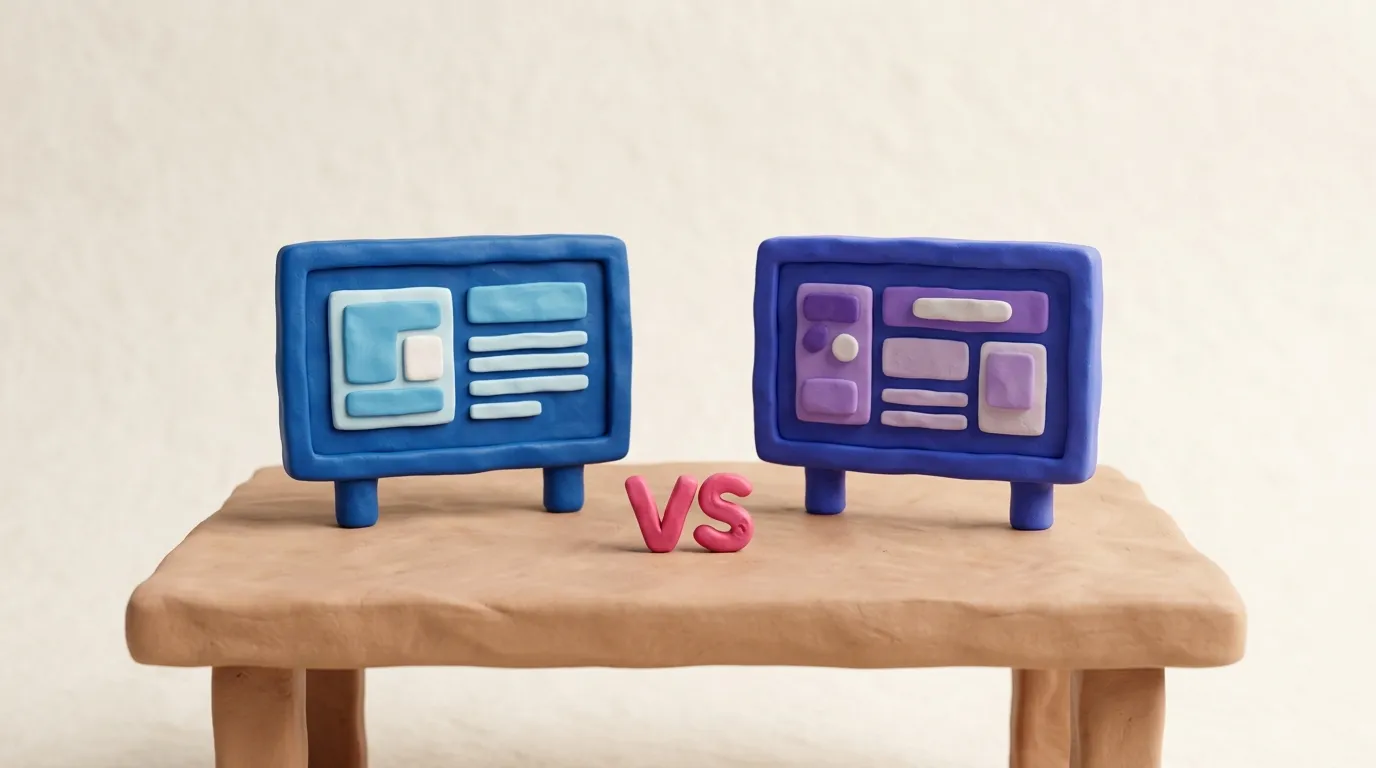
I am going to say something that might sting a little: if you are running the same ad on Meta and LinkedIn, you are leaving money on the table. Probably a lot of money.
I understand the temptation. You created a strong ad, it took real effort, and you want to push it everywhere. "Good creative is good creative," right? Not quite. These two platforms attract different audiences in different mindsets, and the creative that wins on one rarely wins on the other.
The Platform Gap Is Real
Let me break down why these two platforms require fundamentally different creative approaches:
- Audience mindset. Meta users are scrolling for entertainment and social connection. LinkedIn users are scrolling for professional growth and business insights. Totally different headspaces.
- Content expectations. On Meta, people expect visual-first, emotion-driven content. On LinkedIn, they expect value-driven, credibility-focused content.
- Trust signals. Meta audiences respond to social proof (reviews, UGC, before/afters). LinkedIn audiences respond to authority (case studies, data, thought leadership).
Running the same creative on both means it is, at best, a compromise that fits neither audience well. If you want to see how this plays out in practice, our LinkedIn ads teardown breaks down real examples of creative that lands with a professional audience.
Here is how the two platforms compare at a glance:
| Dimension | Meta Ads | LinkedIn Ads |
|---|---|---|
| Audience. | Broad consumer reach across Facebook and Instagram | Professionals, decision-makers, and B2B buyers |
| Targeting. | Interests, behaviors, lookalikes, and detailed demographics | Job title, seniority, company, industry, and skills |
| Typical CPM/CPC. | Lower cost, roughly $5 to $15 CPM and $0.50 to $2 CPC | Higher cost, often $25 to $60 CPM and $5 to $10+ CPC |
| Best for. | Ecommerce, DTC, apps, and high-volume consumer demand | B2B, SaaS, recruiting, and high-value considered purchases |
| Creative format. | Visual-first images, Reels, and Stories in 1:1 or 9:16 | Value-driven single images and document carousels |
| Buying intent. | Lower, interrupt-driven demand generation | Higher for professional needs, slower considered cycles |
Meta Ads: What Actually Works
Meta (Facebook + Instagram) is the land of the scroll. You have approximately 0.3 seconds to make someone stop. Here is what wins:
- Visual-first hooks. Bold colors, high contrast, faces, movement. The image does the heavy lifting, copy supports it.
- Short, punchy copy. Get to the point. The best-performing Meta ad copy is typically 40-80 words for the primary text. Nobody reads your essay, sorry.
- Emotional triggers. Fear of missing out, curiosity gaps, surprise, humor. Make them FEEL something before you ask them to DO something.
- Square or vertical formats. 1:1 for feed, 9:16 for Stories and Reels. Take up as much screen real estate as possible.
- Clear, direct CTAs. "Shop now," "Get started," "Learn more." Do not be clever with your CTA. Be clear.
LinkedIn Ads: What Actually Works
LinkedIn is a completely different game. The audience is in "business brain" mode. Here is what moves the needle (and if you are just getting started, our founder's guide to your first LinkedIn ad campaign walks through setup step by step):
- Value-first headlines. Lead with insight, data, or a contrarian take. Make them think before you make them click.
- Longer copy is okay. LinkedIn audiences actually read. 100-150 words for sponsored content performs well. Share genuine insights, not just sales pitches.
- Professional-but-human tone. Nobody likes corporate robot speak. Be professional but sound like a real person who happens to know their stuff.
- Carousels crush it. LinkedIn carousel ads consistently outperform single images. Tell a story across multiple slides.
- Credibility signals. Numbers, case study results, recognizable logos, testimonials from named individuals (not anonymous quotes).
The Mistakes I See Every Day
Running ads on both platforms, I see the same mistakes over and over:
- Copy-paste creative. Taking the exact same image and copy from Meta and putting it on LinkedIn (or vice versa). The ultimate lazy move.
- Wrong aspect ratios. Running a 9:16 vertical video on LinkedIn desktop. Running a horizontal image on Instagram Stories. It physically hurts to see.
- Tone mismatch. Using Instagram-casual language on LinkedIn ("OMG you NEED this") or corporate-speak on Meta ("Leverage synergistic solutions"). Both are cringe.
- One CTA for all. "Book a demo" on every platform regardless of where the audience is in the funnel. Meta users might need "Learn more" first.
The fix for most of these starts with measuring the right things per platform. Our guide to paid social metrics that matter covers which numbers actually tell you whether your creative is working.
How Adkumo Makes This Easy
Here is the good news: you do not have to become a platform-specific creative expert. Adkumo handles the adaptation automatically.
When you adopt an ad from the repository or create a new one, our AI generates platform-specific versions from a single input. The core message stays the same, but:
- Copy length and tone adjust for each platform
- Image formats adapt to optimal aspect ratios
- CTAs are tailored to platform-appropriate actions
- The overall creative approach shifts to match audience expectations
You think about what you want to say. We handle how it needs to be said on each platform.
Launch to Both, the Smart Way
Better still, you can launch to Meta and LinkedIn directly from Adkumo. No downloading, re-uploading, reformatting, or copying text between tabs.
One message. Two platforms. Optimized creative for each. Your ads work harder, and you spend less time wrangling formats.