%20--%3e%3csvg%20width='42mm'%20height='64mm'%20viewBox='0%200%2041.999999%2064.000001'%20version='1.1'%20id='svg1'%20xml:space='preserve'%20inkscape:version='1.4.4%20(dcaf3e7d9e,%202026-05-05)'%20sodipodi:docname='adkumo-cards-color.svg'%20xmlns:inkscape='http://www.inkscape.org/namespaces/inkscape'%20xmlns:sodipodi='http://sodipodi.sourceforge.net/DTD/sodipodi-0.dtd'%20xmlns='http://www.w3.org/2000/svg'%20xmlns:svg='http://www.w3.org/2000/svg'%3e%3csodipodi:namedview%20id='namedview1'%20pagecolor='%23ffffff'%20bordercolor='%23000000'%20borderopacity='0.25'%20inkscape:showpageshadow='2'%20inkscape:pageopacity='0.0'%20inkscape:pagecheckerboard='0'%20inkscape:deskcolor='%23d1d1d1'%20inkscape:document-units='mm'%20inkscape:zoom='1.4142136'%20inkscape:cx='57.275649'%20inkscape:cy='123.39013'%20inkscape:window-width='1854'%20inkscape:window-height='1011'%20inkscape:window-x='66'%20inkscape:window-y='32'%20inkscape:window-maximized='1'%20inkscape:current-layer='g6528'%20/%3e%3cdefs%20id='defs1'%20/%3e%3cg%20inkscape:label='Layer%201'%20inkscape:groupmode='layer'%20id='layer1'%20transform='translate(-223.82077,-58.584489)'%3e%3cg%20id='g6528'%20transform='translate(9.9863014,0.36985863)'%3e%3crect%20style='fill:%239a5bfd;fill-opacity:1;stroke-width:0.229954'%20id='rect1'%20width='20'%20height='20'%20x='213.83447'%20y='58.21463'%20ry='5'%20/%3e%3crect%20style='fill:%239a5bfd;fill-opacity:1;stroke-width:0.229953'%20id='rect1-8'%20width='20'%20height='20'%20x='235.83447'%20y='102.21463'%20ry='5'%20/%3e%3crect%20style='fill:%23fd3c80;fill-opacity:1;stroke-width:0.229953'%20id='rect1-1'%20width='20'%20height='20'%20x='213.83447'%20y='80.21463'%20ry='5'%20/%3e%3crect%20style='fill:%23fd8902;fill-opacity:1;stroke-width:0.229953'%20id='rect1-1-0'%20width='20'%20height='20'%20x='213.83447'%20y='102.21463'%20ry='5'%20/%3e%3crect%20style='fill:%2305e09b;fill-opacity:1;stroke-width:0.229953'%20id='rect1-1-6-7'%20width='20'%20height='20'%20x='235.83447'%20y='58.21463'%20ry='5'%20/%3e%3crect%20style='fill:%23307eeb;fill-opacity:1;stroke-width:0.229953'%20id='rect1-1-6-7-4'%20width='20'%20height='20'%20x='235.83447'%20y='80.21463'%20ry='5'%20/%3e%3c/g%3e%3c/g%3e%3c/svg%3e)
UGC vs Polished Studio Ads: Which Is Winning on Meta Right Now?
UGC or polished studio ads on Meta? When each format actually wins, what current Meta trends favor, and the hybrid creative portfolio I recommend instead.
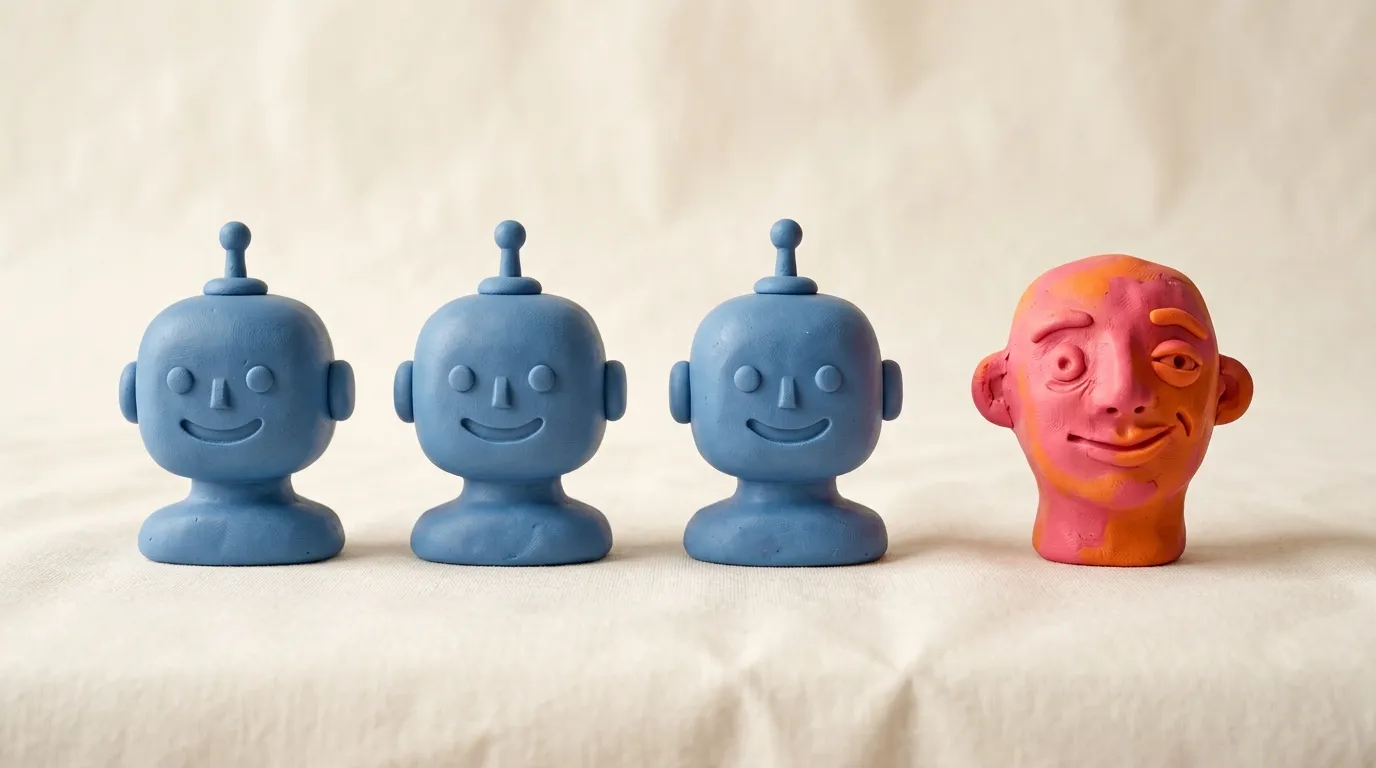
I get asked the same question on almost every account I audit: should we be running scrappy user-generated content, or do we need to invest in polished studio creative? It is usually framed as a budget decision, which is the wrong way to think about it. The honest answer is that both win, just in different places, against different audiences, at different points in the funnel.
I have spent the last several years buying media for ecommerce and B2B brands, and I have watched the pendulum swing hard toward UGC, then quietly swing part of the way back. So let me lay out, without the hype, when each format actually earns its keep on Meta right now, and how I would structure a creative mix that does not bet the whole budget on one aesthetic.
What we are really comparing
Before the debate, a definition, because people conflate two different things. UGC is not just "low production value." It is creative that reads as a real person talking to a camera they are holding themselves: a face, a phone, an unscripted-sounding voiceover, a kitchen or a car or a bathroom mirror in the background. Polished studio creative is the opposite end: controlled lighting, art-directed composition, a designed layout, brand typography, and a deliberate look that signals a company made this on purpose.
The reason this matters is that the two formats are not just different price points. They send different signals, they trigger different psychology, and the platform treats them differently in the feed. So pick based on the job, not the invoice.
When UGC wins
UGC earns its reputation in a few specific situations, and when those conditions are present it is genuinely hard to beat.
- Cold prospecting at the top of the funnel. A stranger scrolling at speed does not want to be sold to. A peer-style clip slips past the ad-blindness reflex because it does not look like an ad, which buys you the two seconds you need to land a hook.
- Trust-dependent and considered purchases. Supplements, skincare, anything you put on or in your body, anything with a return-anxiety problem. Seeing a real person use it and react is worth more than any beauty shot.
- Volume and iteration. The single biggest advantage is throughput. You can produce twenty UGC angles for the cost of one studio shoot, and Meta rewards creative volume because it gives the algorithm more variants to find a winner among. This is the same logic behind turning one winning ad into ten: more shots on goal, faster learning.
- Younger, mobile-native audiences. If your buyers grew up on short-form video, the native handheld look is the grammar they trust by default.
The catch I see most often is that cheap UGC is not free UGC. Bad UGC, off-brand creators, mismatched tone, a hook that does not land, performs worse than a competent static. The throughput advantage only pays off if you keep quality discipline on every clip.
When polished studio wins
The pendulum swung so far toward UGC that a lot of teams forgot studio creative still does things UGC cannot. Here is where I reach for it.
- Premium and aspirational positioning. If your price point or brand promise is "this is the nice one," raw handheld footage actively undercuts you. Production value is the message. A luxury or design-led brand that ships only scrappy UGC reads as cheap, not authentic.
- Product clarity and feature density. When the value is in the details, a controlled shot or a clean designed layout communicates faster than a person waving the thing at a webcam. Studio is better at showing exactly what you get.
- Retargeting and brand recall. Lower in the funnel, where the viewer already knows you, the consistent branded look reinforces recognition and reassures. This is the moment to look like a real company.
- Static placements and instant comprehension. Feed statics, right-hand column, and any placement where a single frame has to do the whole job. A well-designed static still outperforms a lot of video for certain offers, and it is cheap to test.
The honest weakness of studio creative is speed and cost. One polished asset can take a week and a real budget, and if it flops you have one data point instead of twenty. That is the tax you pay for the higher ceiling.
What the current Meta trends actually favor
A few things have genuinely shifted in the last year, and they change the calculus.
- The feed is video-first and sound-on. Reels-style placements dominate delivery, which structurally advantages motion. That tilts the field toward UGC by default, because UGC is natively video, but it does not mean static is dead. It means static has to be excellent to earn its impressions.
- Advantage+ and broad targeting reward creative volume. With targeting increasingly automated, your creative is the targeting. The algorithm needs many variants to explore, which favors whichever format you can produce more of, and that is usually UGC.
- Authenticity fatigue is real. Audiences have now seen so much formulaic "authentic" UGC, the same hook, the same hand gesture, the same on-screen captions, that the format is losing some of its disarming power. A polished, distinctive ad can stand out precisely because everything around it is trying to look unproduced.
- Hybrid formats are quietly winning. The creative that performs best for a lot of my clients right now is neither pure UGC nor pure studio. It is UGC-style footage cut with branded graphics, designed captions, and a clean product end-card. It reads native in the feed but still looks like a competent company made it.
The approach I actually recommend
Stop treating this as a binary. The teams getting the best results do not pick a side, they run a portfolio and let the auction decide. Here is the structure I default to.

- Lead cold prospecting with UGC. Multiple angles, multiple creators, multiple hooks. Volume is the strategy here. Kill the losers fast and pour spend into the one or two that pop.
- Convert with hybrid. Take the UGC angle that is winning and produce a version with branded captions, a designed product reveal, and a clear offer frame. Native feel, higher conversion intent.
- Reinforce with studio. Use your polished, on-brand assets for retargeting and brand placements, where recognition and trust do the work.
- Keep statics in the mix. Designed statics are cheap insurance and they still win specific offers outright. Never run a video-only account by default.
The constraint that quietly kills this strategy is production capacity. Most teams cannot actually produce UGC, hybrids, and on-brand studio statics, across formats and languages, fast enough to feed the algorithm the volume it wants. They pick one format because it is the only one they can keep up with, and then they convince themselves it was a strategy.
The real unlock is production capacity
So the more useful question is not "UGC or studio?" It is "can we produce both, on-brand, fast enough to test our way to the answer?" The format debate is downstream of that. If you can only ship one look, you are not optimizing, you are rationalizing.
This is the part where tooling matters more than taste. The teams that win this do not argue about aesthetics in a meeting, they generate on-brand variations across both registers, push them live quickly, and read the metrics that actually matter. That is increasingly what platforms like Adkumo are built to do: start from proven ad structures, generate on-brand versions, and launch straight to Meta, so the bottleneck stops being your production calendar and starts being your offer. If production capacity is the wall you keep hitting, that is the kind of place worth a look.
But whatever you use to build it, the takeaway holds. UGC and polished studio are not rivals, they are roles. Cast each one where it is strong, produce enough of both to actually test, and let the auction settle the argument your team keeps having.