%20--%3e%3csvg%20width='42mm'%20height='64mm'%20viewBox='0%200%2041.999999%2064.000001'%20version='1.1'%20id='svg1'%20xml:space='preserve'%20inkscape:version='1.4.4%20(dcaf3e7d9e,%202026-05-05)'%20sodipodi:docname='adkumo-cards-color.svg'%20xmlns:inkscape='http://www.inkscape.org/namespaces/inkscape'%20xmlns:sodipodi='http://sodipodi.sourceforge.net/DTD/sodipodi-0.dtd'%20xmlns='http://www.w3.org/2000/svg'%20xmlns:svg='http://www.w3.org/2000/svg'%3e%3csodipodi:namedview%20id='namedview1'%20pagecolor='%23ffffff'%20bordercolor='%23000000'%20borderopacity='0.25'%20inkscape:showpageshadow='2'%20inkscape:pageopacity='0.0'%20inkscape:pagecheckerboard='0'%20inkscape:deskcolor='%23d1d1d1'%20inkscape:document-units='mm'%20inkscape:zoom='1.4142136'%20inkscape:cx='57.275649'%20inkscape:cy='123.39013'%20inkscape:window-width='1854'%20inkscape:window-height='1011'%20inkscape:window-x='66'%20inkscape:window-y='32'%20inkscape:window-maximized='1'%20inkscape:current-layer='g6528'%20/%3e%3cdefs%20id='defs1'%20/%3e%3cg%20inkscape:label='Layer%201'%20inkscape:groupmode='layer'%20id='layer1'%20transform='translate(-223.82077,-58.584489)'%3e%3cg%20id='g6528'%20transform='translate(9.9863014,0.36985863)'%3e%3crect%20style='fill:%239a5bfd;fill-opacity:1;stroke-width:0.229954'%20id='rect1'%20width='20'%20height='20'%20x='213.83447'%20y='58.21463'%20ry='5'%20/%3e%3crect%20style='fill:%239a5bfd;fill-opacity:1;stroke-width:0.229953'%20id='rect1-8'%20width='20'%20height='20'%20x='235.83447'%20y='102.21463'%20ry='5'%20/%3e%3crect%20style='fill:%23fd3c80;fill-opacity:1;stroke-width:0.229953'%20id='rect1-1'%20width='20'%20height='20'%20x='213.83447'%20y='80.21463'%20ry='5'%20/%3e%3crect%20style='fill:%23fd8902;fill-opacity:1;stroke-width:0.229953'%20id='rect1-1-0'%20width='20'%20height='20'%20x='213.83447'%20y='102.21463'%20ry='5'%20/%3e%3crect%20style='fill:%2305e09b;fill-opacity:1;stroke-width:0.229953'%20id='rect1-1-6-7'%20width='20'%20height='20'%20x='235.83447'%20y='58.21463'%20ry='5'%20/%3e%3crect%20style='fill:%23307eeb;fill-opacity:1;stroke-width:0.229953'%20id='rect1-1-6-7-4'%20width='20'%20height='20'%20x='235.83447'%20y='80.21463'%20ry='5'%20/%3e%3c/g%3e%3c/g%3e%3c/svg%3e)
The 12 Best AI Ad Generators in 2026, Tested for Every Creative Type
I tested 12 AI ad generators on real campaigns. Honest breakdowns, pricing, charts, and which tool fits static, video, UGC, and B2B ads in 2026.
I have spent the last two months putting AI ad generators through the same gauntlet: one DTC skincare brief and one B2B SaaS brief, run through every tool on this list, judged on what I could actually ship. The category has split into camps. Some tools generate static creative at volume, some produce UGC-style video with synthetic actors, some are really product photo studios, and one or two try to own the whole journey from idea to live campaign.
This is my honest map of the twelve worth knowing in 2026, sorted by what each one is genuinely best at. Full disclosure: this blog is published by Adkumo, and Adkumo is on the list. I have tried to hold it to the same standard as everything else, cons included, and you can check my earlier AI ad tools roundup to see that the honest treatment cuts both ways.
How I tested these AI ad generators
Every tool got the same two briefs. The first was a DTC product with strong existing brand assets: real photography, a defined palette, a voice document. The second was a B2B SaaS product with almost nothing, which is the situation most early teams are actually in. I scored each tool on five axes.
- Creative quality. Would I put real ad spend behind the output without a designer cleaning it up first?
- Brand consistency. Does the tenth output still look like the brand, or has the tool drifted back to its house style?
- Starting point. Blank prompt, or something proven? Tools that start from ads that already worked produce stronger creative far more reliably.
- Formats. Static, video, or both, and in which aspect ratios.
- The handoff. Can it push the finished ad to the channel where it will run, or does the workflow end with a zip file and a manual upload?
That last axis matters more than most buyers expect. The export-and-reupload loop is where ad velocity quietly dies, and it is the axis where the twelve tools differ most.
Overview: the 12 best AI ad generators compared
The whole field in one table. Prices are the cheapest paid plan I could verify in July 2026, rounded, and several of these companies change pricing often, so treat them as a starting point.
| Tool | Best for | Standout features | Limitations | Starts at |
|---|---|---|---|---|
| Adkumo | Brand-consistent static ads, launched | Proven-ad repository, one-click brand adoption, Meta + LinkedIn launch | Static focus, no video generation | Free / $39/mo |
| AdCreative.ai | High-volume performance creative | Conversion scoring, bulk generation, Meta + Google push | Repetitive layouts, credit billing | ~$39/mo |
| Arcads AI | UGC-style AI-actor video | 1,000+ AI actors, hook generator, 30+ languages | Video only, premium pricing | ~$110/mo |
| Creatify.ai | Product-URL-to-video ads | URL to video, avatars, Meta + TikTok publish | Vertical-video focus, credit pressure | ~$19/mo |
| TagShop AI | Budget UGC video | Link-to-video agent, digital twins | Manual resizing, credit burn | ~$11/mo |
| ImagineArt | All-in-one image + video suite | Multi-model access, Ad Studio, ratio presets | Daily caps on free, commercial use is paid | ~$7/mo |
| Invideo AI | Long-form and pro video | 16M+ stock assets, text-to-video edits, 50+ language voiceovers | Learning curve, watermarked free tier | ~$35/mo |
| Akool | Localization and avatars | 8K output, 150+ languages, face swap | Uncanny avatars, credit loss on failed renders | ~$30/mo |
| Quickads | Fast AI visuals with scoring | Ad scoring, Meta integration, virtual try-ons | Stylized output, pricing moved upmarket | ~$99/mo |
| Mintly | E-commerce ad cloning | 1-click cloning of real ads, product-accurate renders | Template-dependent, no free downloads | ~$19/mo |
| Flair.ai | AI product photography | 3D scene builder, custom model training | No ad publishing, text rendering issues | ~$10/mo |
| Canva | DIY design breadth | Magic Studio, URL-to-ad Grow flow, Meta publish | Not performance-native, generic AI output | ~$13/mo |
- ImagineArt7 $/mo
- Flair.ai10 $/mo
- TagShop AI11 $/mo
- Canva Pro13 $/mo
- Creatify.ai19 $/mo
- Mintly19 $/mo
- Akool30 $/mo
- Invideo AI35 $/mo
- Adkumo39 $/mo
- AdCreative.ai39 $/mo
- Quickads99 $/mo
- Arcads AI110 $/mo
The price spread tells you something about the category. The under-$15 tools are single-purpose generators. The $30-and-up tools either bundle distribution, like Adkumo and AdCreative.ai, or sell synthetic actors, like Arcads, where the licensing cost of realistic AI people is baked into every plan.
What is the best AI ad generator in 2026?
Here is each tool in detail, in the order I would recommend them to a typical lean marketing team: what it does, where it shines, and the catch nobody puts on the pricing page.
1. Adkumo (best overall for brand-consistent ads you can actually launch)
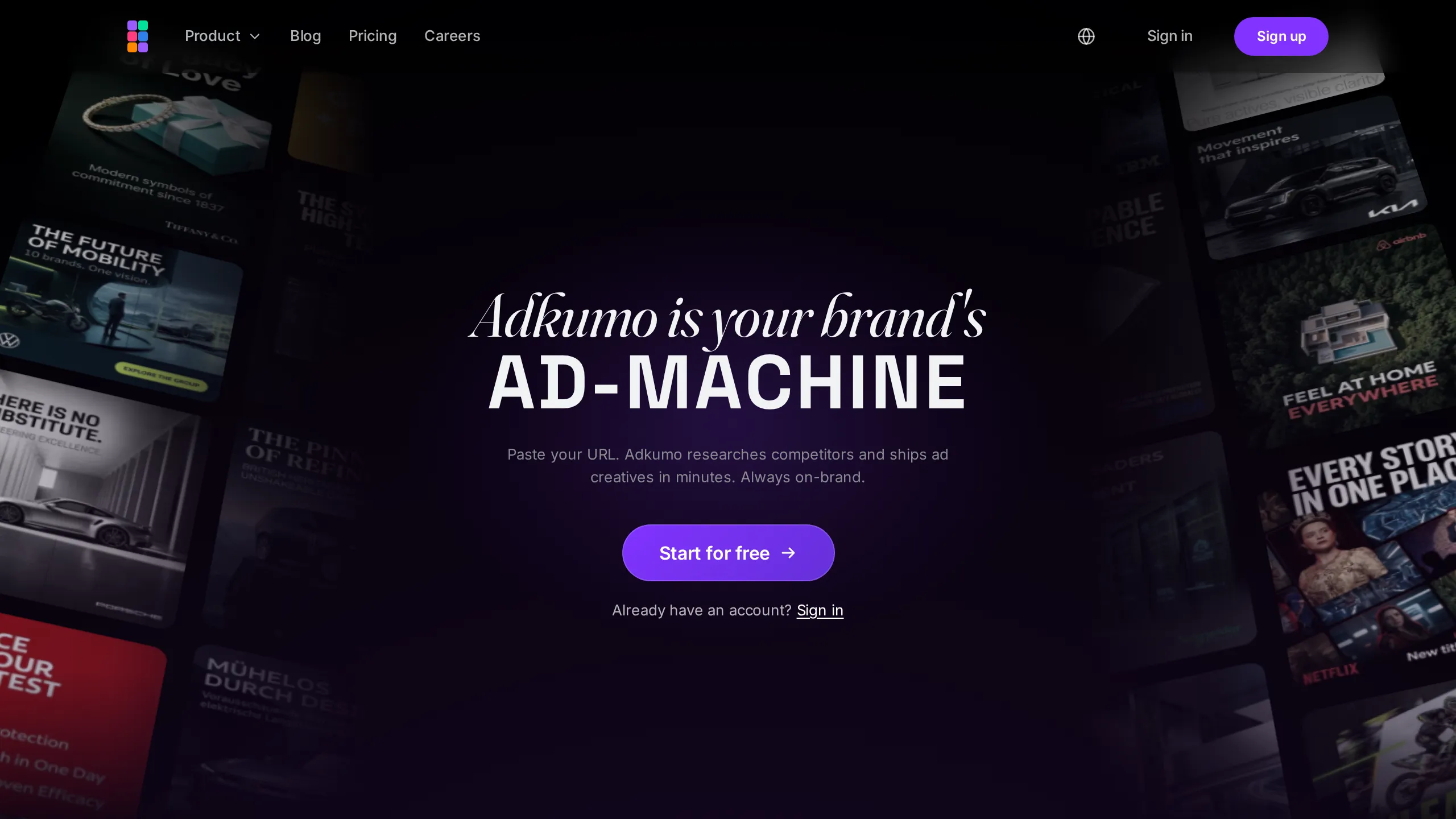
Adkumo is built around a premise the pure generators skip: your next winning ad probably already exists, so start from proven creative instead of a blank prompt. You browse a curated repository of real ads, pick one that fits, and adopt it to your brand in one click. The system applies your brand DNA, meaning voice, colors, and typography, generates on-brand variations, and lets you refine the result in a chat instead of a timeline editor. Then comes the part that made it my default recommendation: the finished ad launches directly to Meta Ads and LinkedIn Ads from the same screen. Nothing else on this list launches to LinkedIn at all.
On my two briefs it was the only tool where the tenth output still looked like the brand, and the multilingual generation held the same voice across English, German, French, and Italian, which matters if you run multilingual campaigns.
Key features. Curated repository of proven ad creatives, one-click adoption with brand DNA, conversational refinement, ad quality scoring, four-language generation, and direct launch to Meta and LinkedIn.
Limitations. It is static-image focused, so UGC video is not its game. It is also newer than most names here, and the repository-first workflow is a different mental model if you are used to prompting from scratch.
Pricing. A real free plan with one brand and fifteen image generations a month, then $39 a month for Starter and $89 for Growth. Launches are unlimited on every plan.
2. AdCreative.ai (best for high-volume performance marketing)
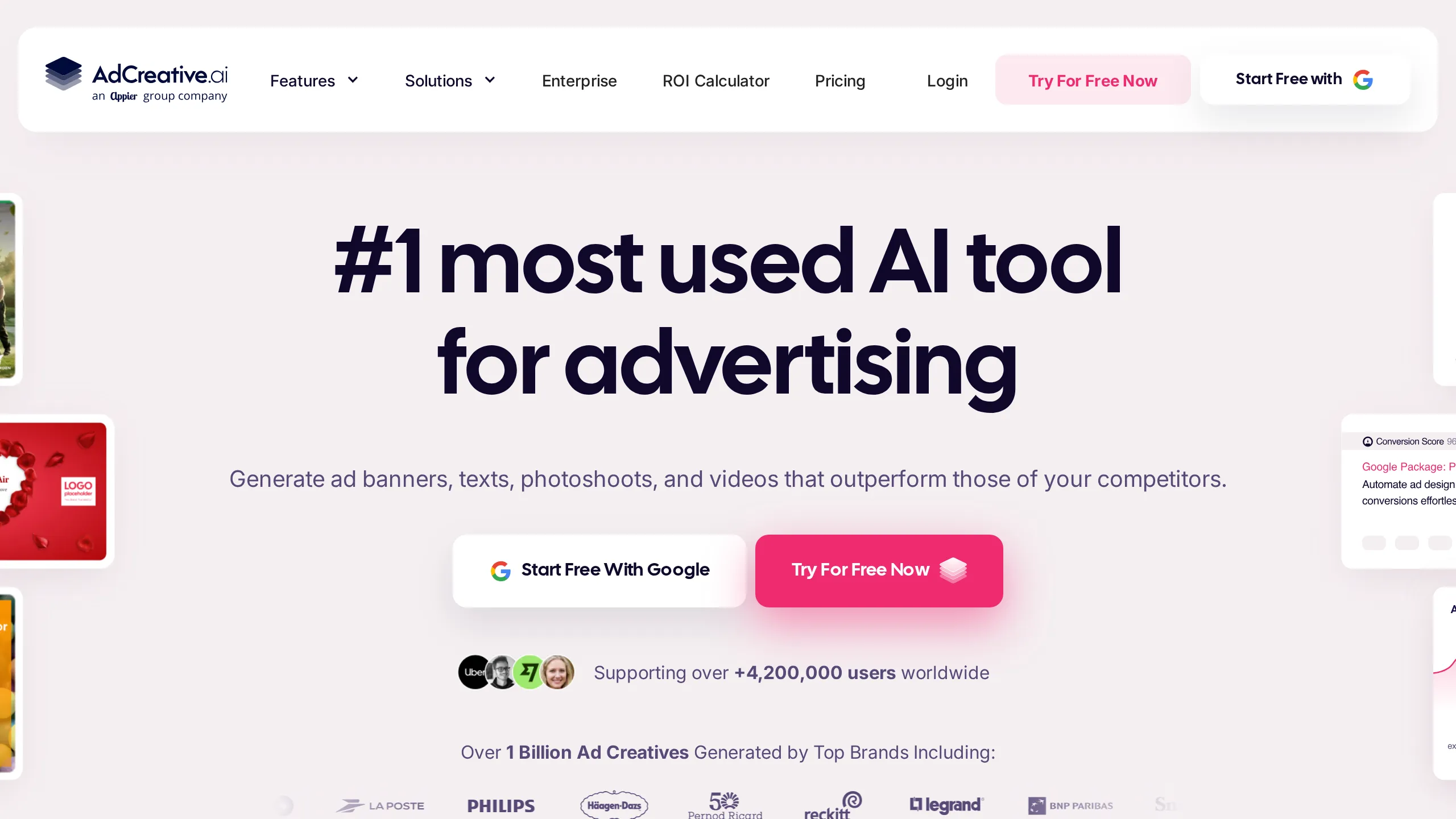
AdCreative.ai remains the volume king. Feed it your product and brand kit and it produces banners, texts, photoshoots, and short clips by the dozen, each stamped with a predicted conversion score, with direct push to Meta and Google. For a media buyer who needs twenty variants tonight, it delivers, and its competitor-insight features are genuinely useful for figuring out what the rest of your category is running.
Key features. Conversion-score prediction, bulk static generation, AI product photoshoots, competitor insights, Meta and Google publishing.
Limitations. The layouts start repeating themselves at scale, the trial wants a card upfront, and the billing model has a reputation: roughly 4.3 on G2 against about 3.6 on Trustpilot, with the gap driven by surprise-charge complaints. I broke down the escape routes in my AdCreative.ai alternatives piece.
Pricing. From about $39 a month on monthly billing, tiers climbing steeply with credit allowances.
3. Arcads AI (best for UGC-style AI-actor video ads)
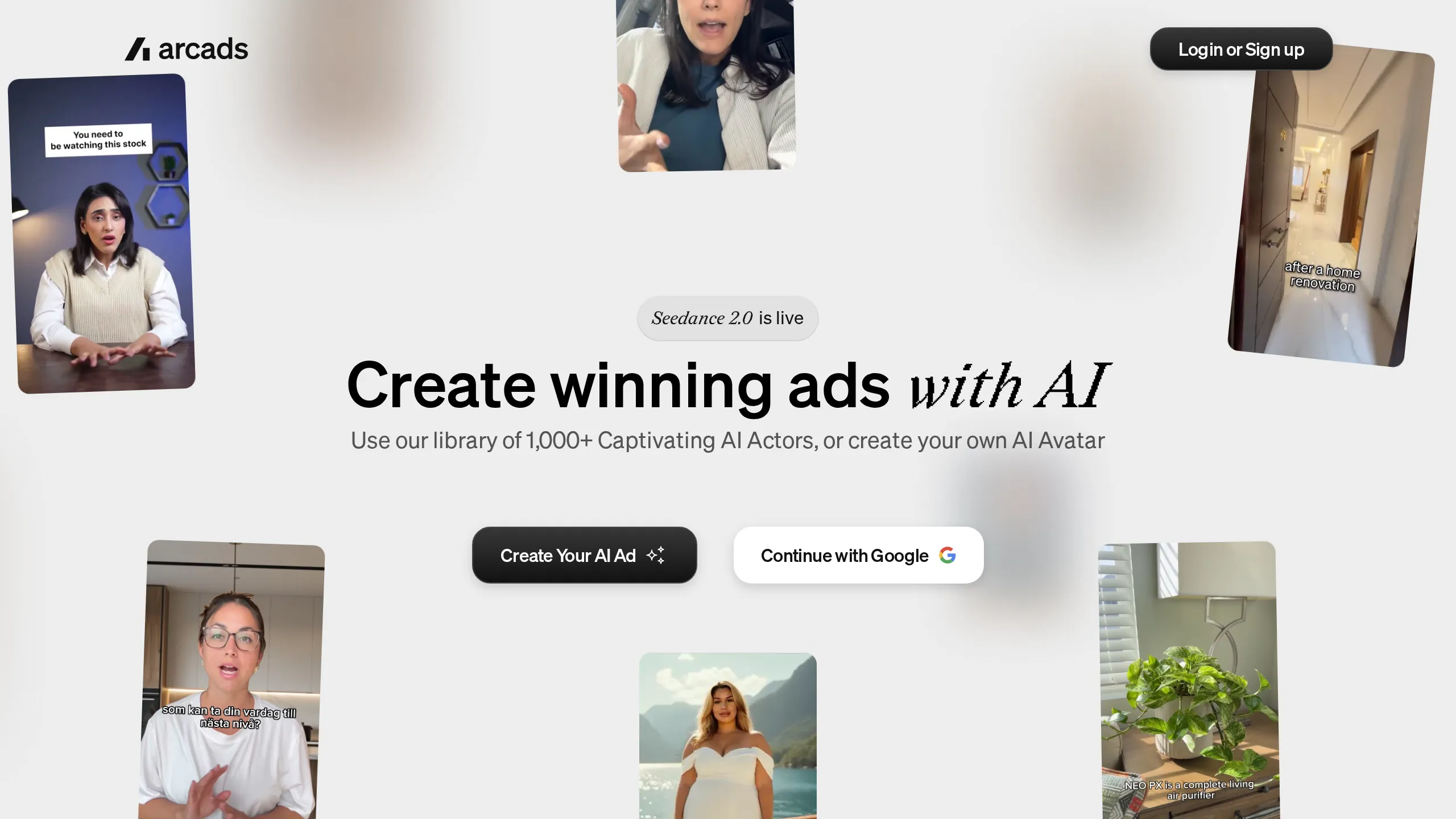
Arcads is the tool that made AI actors a serious option for performance teams. You write or generate a script, pick from a library of over a thousand AI actors, and get back a direct-to-camera UGC-style video with gestures, emotion control, and captions that would pass for a paid creator on most feeds. The hook generator, which drafts opening lines from a library of proven hooks, is the kind of practical touch that shows the team runs ads themselves. Localization into 30+ languages makes it a strong pick for international testing.
Key features. 1,000+ AI actors, custom avatar creation, emotion control, hook generator, AI editing with B-roll and captions, 30+ language localization.
Limitations. Video only, so your static mix needs another tool. There is no public pricing page or free trial, actor quality varies noticeably across the library, and its Trustpilot score sits around 3.2 with a sharp split between five-star and one-star experiences, mostly about billing and credit mechanics.
Pricing. Reported at about $110 a month for ten video credits on Starter, $220 for twenty, with discounts appearing regularly.
4. Creatify.ai (best for product-URL-to-video ads)
Creatify owns the lowest-friction path from product page to video ad. Paste a URL and it assembles avatar-led clips with captions and overlays, fans out variations for A/B testing, tracks competitors, and publishes directly to Meta and TikTok. The backgrounds have a lived-in, handheld quality that reads more authentic than most synthetic footage, which is exactly what you want for UGC-style creative.
Key features. URL-to-video, large avatar roster in 75+ languages, batch generation, built-in A/B testing, competitor tracking, Meta and TikTok publishing.
Limitations. Vertical video is the center of gravity, static gets no help, and the credit meter drains faster than the pricing page implies. Trustpilot sits around 4.1 across roughly 800 reviews, with credit accounting the recurring gripe.
Pricing. Free tier with capped credits, then from about $19 a month.
5. TagShop AI (best budget pick for UGC video)
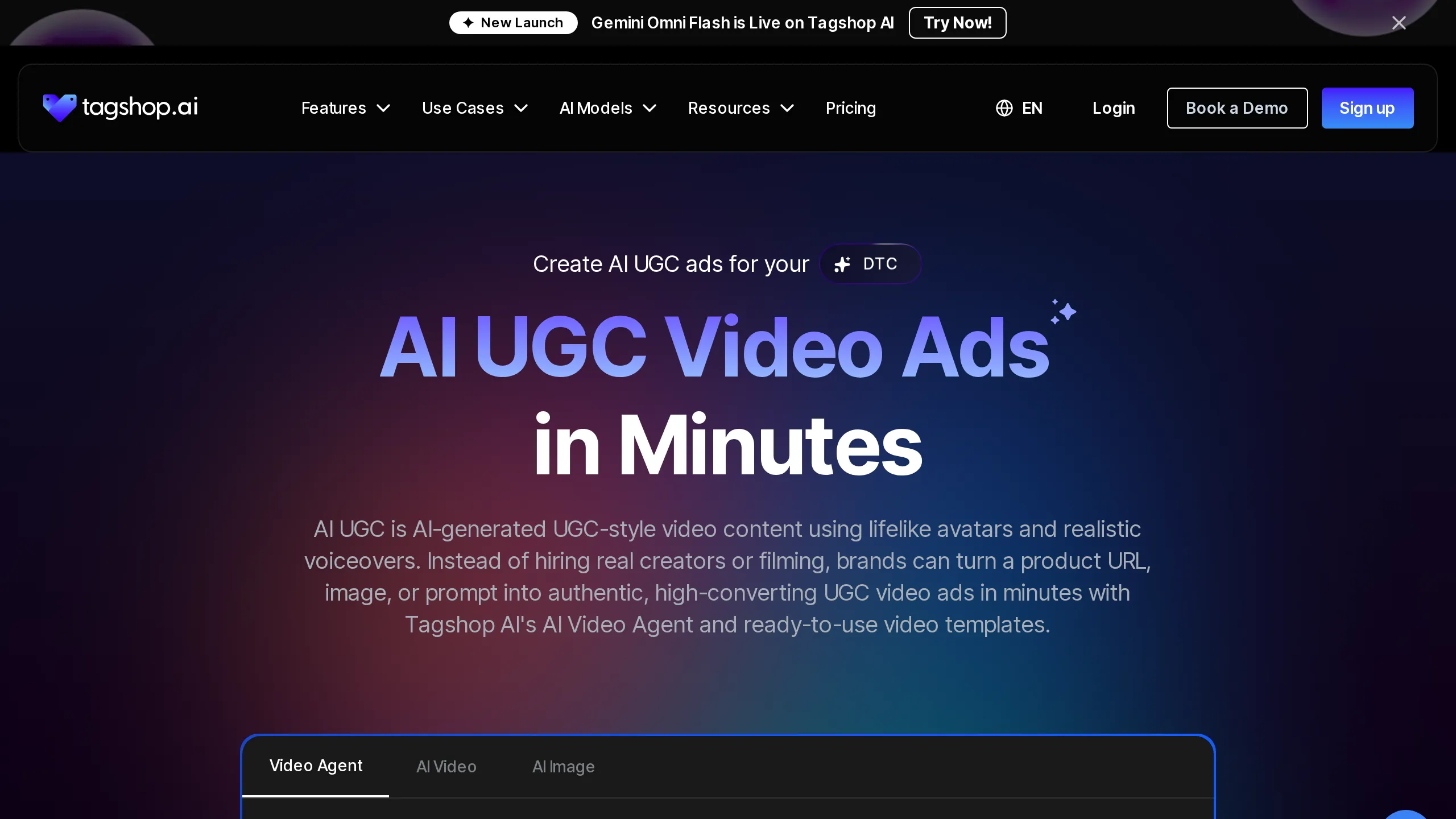
TagShop plays in the same UGC-video space as Arcads and Creatify at a fraction of the entry price. Its video agent walks from product link to export-ready clip in a chat flow, its digital-twin feature builds a reusable avatar of a real person, and the output quality has closed most of the gap with the premium tools for straightforward product-demo formats.
Key features. Link-to-video agent, digital twins, realistic avatar library, template-driven ad formats.
Limitations. Aspect-ratio handling is clumsy, so plan on manual resizing for anything beyond vertical, and complex briefs chew through credits quickly. No publishing integrations, so everything exports to your ad manager by hand.
Pricing. From about $11 a month, which is the cheapest ticket into credible AI UGC video on this list.
6. ImagineArt Ads Studio (best all-in-one suite on a budget)
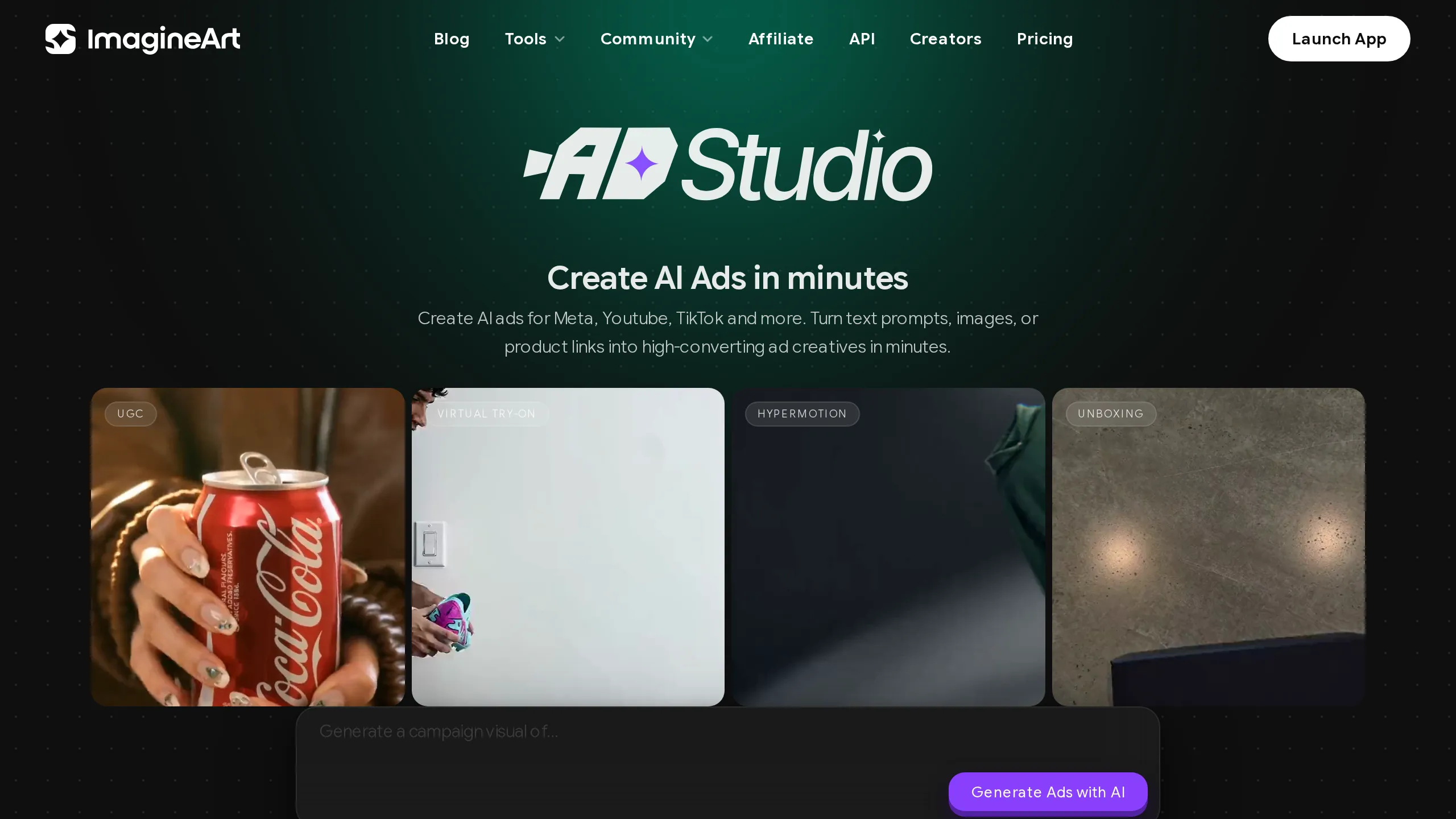
ImagineArt started as a general image generator and its Ad Studio has grown into a credible creative suite: image ads, video ads, virtual try-on, unboxing formats, all driven from a prompt, an image, or a product link, with access to multiple frontier models under one subscription. For a solo founder who wants one cheap tool that does a bit of everything, it is the strongest value play here.
Key features. Multi-model access under one plan, image and video ad generation, aspect-ratio presets, UGC and try-on formats.
Limitations. The free plan has daily caps and commercial usage rights require a paid plan. There is no brand system, no scoring, and no publishing, so it is raw generation rather than an ad workflow.
Pricing. Free with daily limits, paid plans from roughly $7 to $13 a month.
7. Invideo AI (best for professional-grade video production)
Invideo is a full video platform rather than an ad generator, and that is its appeal. Describe the video and it drafts script, scenes, stock footage from a 16-million-asset library, and a voiceover in any of 50+ languages, then lets you edit by typing instructions instead of dragging clips. Agencies and YouTube-first teams get the most from it; for pure paid-social clips it is more machine than you need.
Key features. Text-to-video with editable scenes, 16M+ stock assets, natural voiceovers in 50+ languages, instruction-based editing.
Limitations. The learning curve is real, renders queue at busy times, and the free tier watermarks everything. No ad-platform publishing.
Pricing. From about $35 a month. G2 sits around 4.3.
8. Akool (best for localization and global campaigns)
Akool is the specialist for taking one campaign global. Its video translation re-voices and lip-syncs existing footage across 150+ languages, its avatar and face-swap tools localize talent without reshoots, and output resolution goes up to 8K, which nothing else in this roundup matches. Reviewers rate it highly, 4.8 on G2 across 550+ reviews, though the Trustpilot picture is more mixed.
Key features. Video translation with lip-sync in 150+ languages, avatars and face swap, 4K and 8K output, live-stream avatar tools.
Limitations. Avatars can slip into the uncanny valley on close inspection, users report credits being consumed by failed renders, and there is no ad publishing.
Pricing. From about $30 a month, credit-based.
9. Quickads (best for fast AI visuals with built-in scoring)
Quickads pairs fast static generation with an ad-scoring engine that grades your creative before you spend on it, plus practical e-commerce features like virtual try-ons. Over the past year it has moved upmarket, wrapping the software in a service layer aimed at teams that want the output managed for them, and the entry price has moved with it.
Key features. AI ad scoring, quick static and visual generation, virtual try-ons, Meta integration, done-with-you service tiers.
Limitations. The default output style skews dreamy and stylized, which reads as AI on plainer feeds, and the shift upmarket means it is no longer the impulse-buy tool it was at launch. G2 sits at 4.4 on a small review base of about 17.
Pricing. A $1 seven-day trial, then reported from about $99 a month for full access.
10. Mintly (best for e-commerce teams cloning proven layouts)
Mintly is the closest philosophical cousin to Adkumo on this list: it also believes proven layouts beat blank prompts. Paste your store URL and it extracts product photos and benefits, then lets you clone the structure of real winning ads from big consumer brands and rebuild them with your own product, with a protection filter that keeps the product render accurate. For DTC teams that live inside Meta Ad Library screenshots, that cloning loop is addictive.
Key features. 1-click ad cloning, product-accurate rendering, UGC video presets, 2,000+ templates, store-URL ingestion.
Limitations. Everything downstream depends on its template library, there are no free downloads on the free tier, and there is no publishing, scoring, or LinkedIn-shaped anything: it is an e-commerce Meta tool through and through.
Pricing. From about $19 a month.
11. Flair.ai (best for AI product photography)
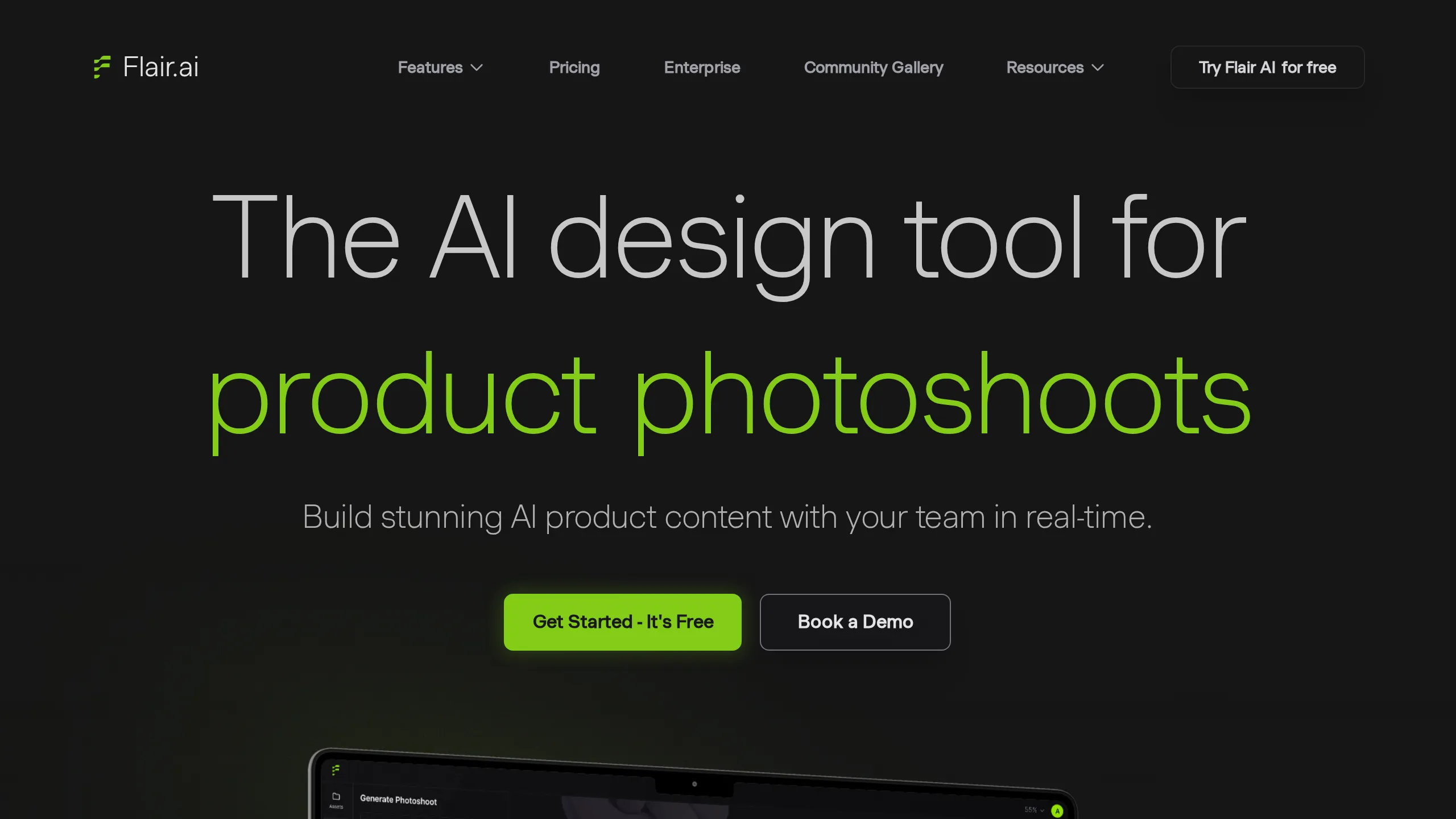
Flair is what I reach for when the ad problem is really a photography problem. You stage your product in a drag-and-drop 3D scene, pick lighting and props, and generate photoshoot-grade imagery, including virtual fashion shoots with AI models trained on your own product. The control level is closer to a studio than a prompt box, which is exactly what brand-side design teams want.
Key features. 3D scene construction, custom model training, virtual fashion shoots, batch photography workflows.
Limitations. It stops at the image: no copy, no formats, no publishing, and rendered text still comes out mangled often enough that you will add headlines elsewhere.
Pricing. Free tier, then from about $10 a month.
12. Canva Magic Studio (best for DIY design breadth)
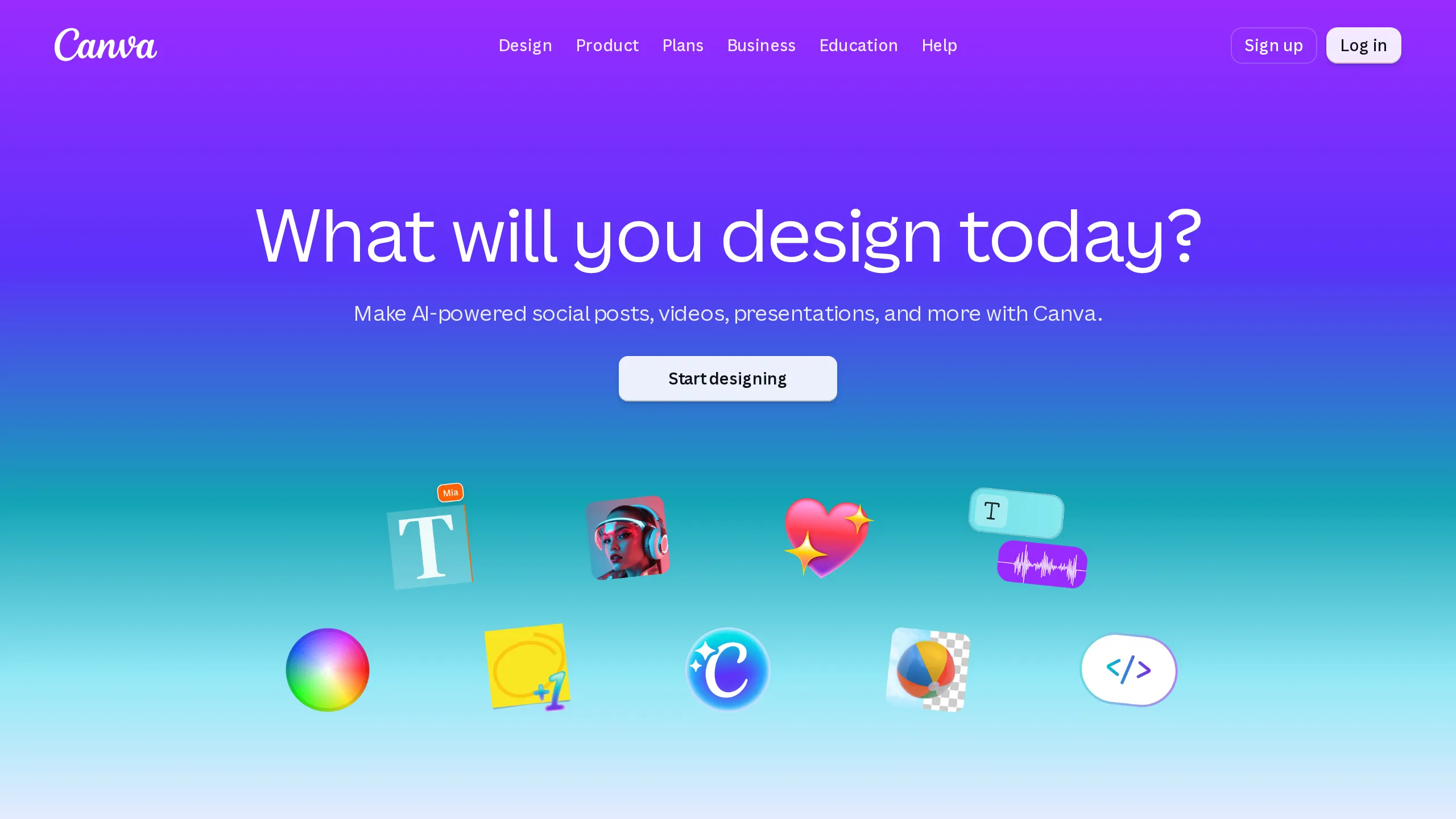
Canva earns the last spot not because it is the best ad generator, it is not, but because for thousands of small teams it is the tool they already pay for. The Magic Studio layer drafts layouts and copy, the newer Grow workflow builds ads from a live product URL and publishes directly to Meta, and the Brand Kit keeps fonts and colors consistent. If your ad needs are occasional and your design needs are constant, it is the rational choice, as I argued in my Canva alternatives breakdown.
Key features. Magic Design and Magic Write, URL-to-ad Grow workflow with Meta publishing, Brand Kit, an enormous template library.
Limitations. It is not performance-native: no proven-ad library, no scoring, and the Grow flow currently restricts uploading new assets mid-workflow. AI image output is a generation behind the dedicated models. G2 4.7 across 6,800+ reviews reflects the design suite, not the ad workflow.
Pricing. Real free tier; Pro from about $13 a month.
Which generators actually launch your ads?
This is the axis that separates a creative toy from an ad workflow, so it deserves its own table. Starts from proven ads means the tool begins with creative that has already run somewhere, rather than a blank prompt.
| Tool | Static ads | Video ads | Starts from proven ads | Launches to Meta | Launches to LinkedIn |
|---|---|---|---|---|---|
| Adkumo | Yes | No | Yes | Yes | Yes |
| AdCreative.ai | Yes | Partial | No | Yes | No |
| Arcads AI | No | Yes | No | No | No |
| Creatify.ai | No | Yes | No | Yes | No |
| TagShop AI | No | Yes | No | No | No |
| ImagineArt | Yes | Yes | No | No | No |
| Invideo AI | No | Yes | No | No | No |
| Akool | No | Yes | No | No | No |
| Quickads | Yes | Partial | No | Yes | No |
| Mintly | Yes | Yes | Partial | No | No |
| Flair.ai | Yes | Partial | No | No | No |
| Canva | Yes | Partial | No | Yes | No |
Read that LinkedIn column again. B2B teams spend serious money there, the creative requirements differ from Meta in specific ways, and eleven of twelve generators end the workflow with a manual upload. That gap is most of the reason Adkumo sits at the top of my list for lean B2B teams.
- Akool4.8
- Canva4.7
- Quickads4.4
- AdCreative.ai4.3
- Invideo AI4.3
- Creatify.ai4.1
- Arcads AI3.2
Scores as of July 2026, using each tool's largest independent review base: G2 for Akool (550+), Canva (6,800+), Quickads (17), AdCreative.ai (790+), and Invideo, and Trustpilot for Creatify (800+) and Arcads. Small review bases move fast, and AdCreative.ai is the clearest case of a G2-versus-Trustpilot split, so click through before you treat any single number as truth. Adkumo, TagShop, ImagineArt, Mintly, and Flair do not yet have review bases large enough to chart honestly, so I left them out rather than inventing a number.
What AI ad generators can (and can't) do
After two months inside these tools, the pattern is clear. They are genuinely good at three things: volume, speed, and competence. Twenty on-format variants before lunch is now table stakes. The floor has risen so far that a solo founder can ship creative that would have needed a freelancer in 2023.
What they still cannot do reliably is judgment. No generator knows that your legal team bans superlatives, that your audience finds avatar smiles unsettling, or that last quarter's best-performing hook is now fatigued. Brand consistency remains the biggest gap: most tools hold your colors for one generation and drift by the tenth. And almost none of them close the loop to the ad account, which is where the real time cost lives. The teams getting results treat these tools as a fast first draft plus a human edit, aimed at structured creative testing, not as an autopilot.
How to choose the right AI ad generator
Map your actual creative type to the tool built for it and skip the rest of the list.
- Brand-consistent static ads, launched to Meta and LinkedIn. Adkumo, and it is the only LinkedIn option here.
- Maximum static volume with scoring. AdCreative.ai, if you watch the billing.
- UGC-style actor video at premium quality. Arcads AI.
- UGC video on a budget. TagShop AI first, Creatify.ai when you want publishing built in.
- One cheap tool for a bit of everything. ImagineArt Ads Studio.
- Long-form or agency video. Invideo AI.
- Global localization of existing creative. Akool.
- Scored visuals with a service layer. Quickads.
- E-commerce ad cloning. Mintly.
- Product photography. Flair.ai.
- Everyday design with occasional ads. Canva.
Frequently asked questions
What is the best AI ad generator in 2026?
There is no single winner, only a best tool per creative type. For brand-consistent static ads you can launch directly to Meta and LinkedIn, Adkumo leads. For UGC-style AI-actor video, Arcads AI is the quality benchmark and TagShop AI the budget pick. For sheer static volume with performance scoring, AdCreative.ai still delivers.
Can AI generate ads for Meta and LinkedIn directly?
Generating the creative is easy; launching it is rare. Adkumo launches finished ads to both Meta Ads and LinkedIn Ads. AdCreative.ai, Creatify.ai, Quickads, and Canva push to Meta. Every other tool in this roundup ends with an export and a manual upload, and none of the others touch LinkedIn.
Are AI-generated ads allowed on Meta and LinkedIn?
Yes. Both platforms accept AI-generated creative and ship their own AI creative tools, and your ads still have to pass the same content policies as any other creative. The practical caveats: photorealistic synthetic people may require disclosure in regulated verticals, and misleading claims get rejected regardless of who or what made the image.
What is the best free AI ad generator?
Canva's free tier is the most complete for general design. Adkumo's free plan includes one brand and fifteen image generations a month with unlimited launches, which makes it the strongest free option for ads you actually intend to run. ImagineArt's free plan works for experimentation but caps daily usage and reserves commercial rights for paid plans.
Can AI ad generators keep my ads on brand?
Most drift. Brand kits in tools like Canva and AdCreative.ai hold logos and colors but not voice, and by the tenth variation the house style of the model tends to win. Adkumo is built around this exact problem: it applies a full brand DNA, meaning voice, tone, colors, and typography, to every variation, which is why consistency, not creativity, is the argument at the center of this blog.
Ship on-brand ads, not just AI ads
Twelve tools, three real jobs: make the creative, keep it on brand, get it live. Most of this list is excellent at the first job, patchy on the second, and silent on the third. The pure generators will keep getting better and cheaper, which makes the differentiators everything around generation: proven starting points, a brand system that survives variation ten, and a launch button wired to the channels you actually spend on.
If your week looks like mine, static-heavy, B2B-adjacent, and allergic to the export-reupload loop, start with the free plan at Adkumo and browse the repository before you write a single prompt. If your bet is synthetic UGC video, take the Arcads trial invoice seriously but test TagShop first. Whatever you pick, choose for your workflow, not the demo reel, and revisit the choice in six months, because this category does not sit still.